The Proofreader Was the Point
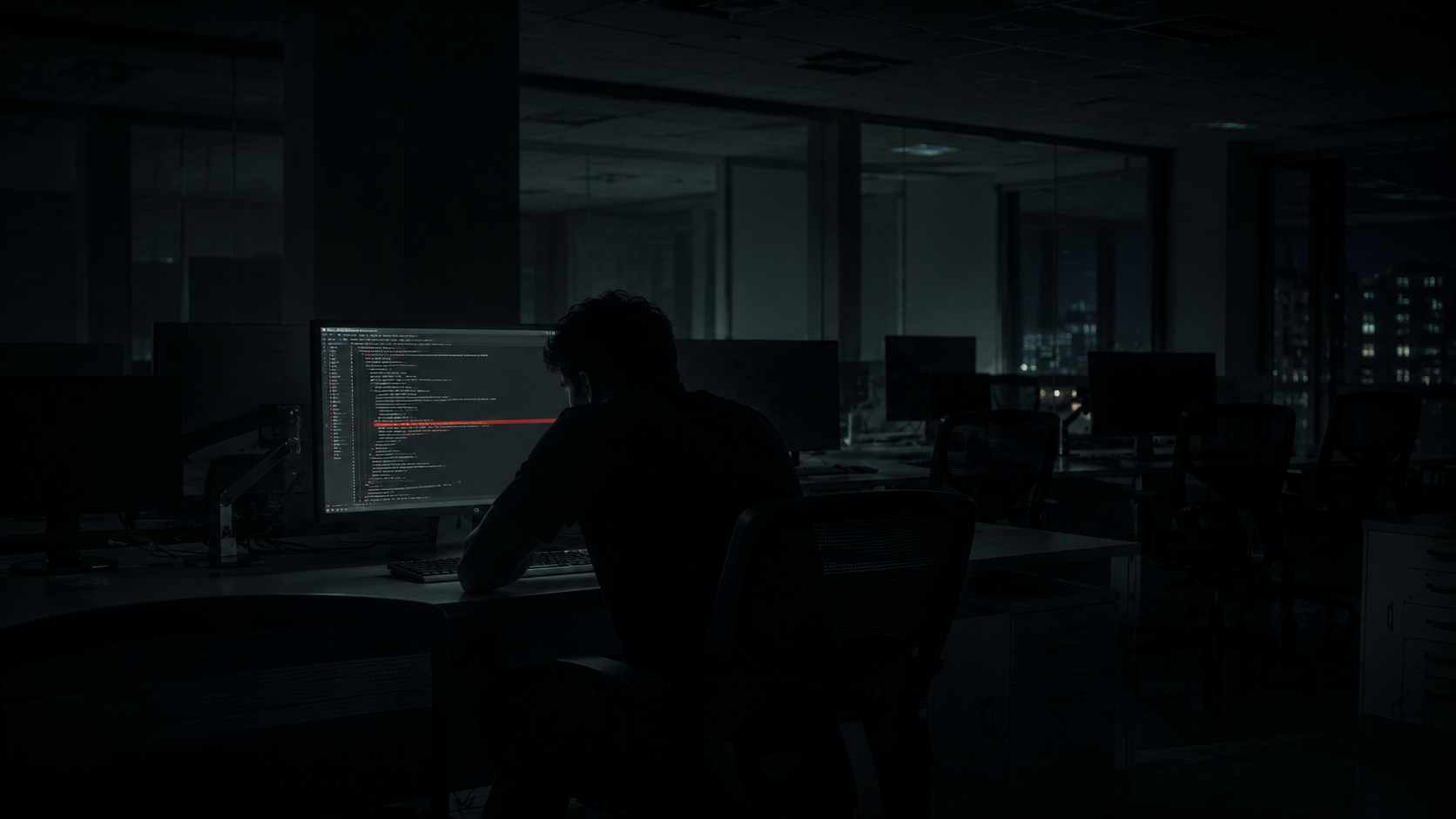
Coders keep calling themselves proofreaders now, like it's a comedown. They're describing the most important seat in the building and apologizing for sitting in it.
Every day I watch a coder on Facebook make the same joke. My job now is basically proofreading the AI.It always lands the same way — half a laugh, a little embarrassed, like they've been caught doing something that isn't quite real engineering anymore. And underneath the joke, every time, the same quiet question: is that really still worth two hundred grand? I want to answer that question, because I think they have the value upside down, and I think I can see it from an angle most of them can't. I came up from the bottom of this exact hierarchy. I'm QA.
First, the part that isn't a feeling. The producing half of the job really is being automated, and not slowly. In April, Google said about three-quarters of its new code is now generated by AI and reviewed by human engineers. OpenAI's president said the tools have gone from writing twenty percent of your code to eighty. Spotify's co-CEO said the company's best developers haven't written a single line of code since December — they supervise the thing that writes it. Put those three quotes next to each other and read only the verbs left over for the humans. Reviewed. Supervise. Proofread. The writing is leaving. What remains is the judging.
Now the part nobody on my old org chart wants to say out loud. For thirty years software ran a caste system, and I lived at the bottom of it. Architects and senior engineers on top — the builders, the creators, the people who made things. QA at the bottom: the ones who, the joke went, couldn't build, so they broke. We were the cost center. The gate you resented on the way to shipping. The skill we were paid for was quietly treated as the least valuable in the building. Then AI walked in and automated the top of that chart — the producing, the typing, the celebrated part — and left the bottom almost untouched. Because the bottom is the one thing it is worst at.
Here is what the proofreader jokes miss. The AI's defining failure is not that it's wrong. It's that it's wrong confidently— it hands you something that compiles, reads clean, passes the happy path, and is quietly lying about the one edge case that takes the system down at two in the morning. Catching that is not proofreading the way you proofread a memo. It is an adversarial discipline: you assume the output is guilty until it proves itself innocent. You go hunting for the input nobody imagined, the state that shouldn't be reachable, the thing that works in the demo and dies in production. That is the entire job of QA. It always was. We just used to aim it at human authors — and now there is an infinite, tireless, supremely confident author who needs that scrutiny more than any human ever did.
So — is a proofreader worth two hundred thousand dollars? If “proofreader” means someone who skims the machine's output, sees that it looks fine, and clicks approve, then no. That person is worth less than nothing, because they're a rubber stamp on a confident liar. But that was never what the money was for. The two hundred grand was never paid for typing speed or for memorizing syntax; you could never pay a human enough to out-type a model. It was always, secretly, for judgment under uncertainty— for being the one person who can look at something that looks right and know that it isn't. The market mispriced that for three decades because production was scarce and judgment was assumed. Now production is free and judgment is the only scarce thing left in the room. The salary is not going to follow the people who can write code. It is going to follow the people who can tell when the code is wrong.
I can say all of this with a straight face because I am a walking version of both halves. Three months ago I could not write a line of code. I built this entire site with AI — so I am proof the producing half is real, that the machine can hand a non-engineer a working publication. But the only reason this site is not garbage is the other half: I do not trust a single thing it gives me. I read its output the way I read a pull request at my day job — assuming there is a bug in it I have not found yet, because there usually is. That reflex is the whole difference between what I built and the ocean of AI slop it could have been.
And it is the same reflex I write about on the rest of this site under a different name. Being tethered to AI is leaning on something that feels right and is confidently wrong, and slowly losing the muscle that used to check it. The QA mindset — verify, don't trust; assume it's lying; go find the edge — is not only the most important skill in the new tech cycle. It is the antidote to the dependency the whole rest of this publication is about. The proofreaders are not being demoted. They are the only ones still holding the line between “it looks right” and “it is right,” and that line is the entire game now.
So when the joke scrolls past again tonight — my job is just proofreading the AI now, lol— I don't read it as a comedown. I read it as a confession from people who have been handed the most important seat in the building and haven't looked up long enough to read what's printed on the back of the chair. It says QA. It always said QA. Worth every penny.
— Michael
itethered.com
written by Michael · 6/5/26
The receipts
Google — ~75% of new code AI-generated, reviewed by human engineers (Apr. 2026): aol.com
OpenAI's president — AI has gone “from 20% to 80% of your code” (May 2026): businessinsider.com
Spotify — best developers haven't written a line of code since December; engineers “supervise” the AI, and reviewing it can be more work than writing (Feb. 2026): techcrunch.com
Google engineers shifting from coding to “calling the shots”; Dora 2025 found 90% of software workers using AI (Mar. 2026): businessinsider.com
The quality problem the reviewing exists to catch — AI code security “varies significantly” (Dec. 2025): darkreading.com