Even Microsoft Got Tethered
In 2023, the fastest way for Microsoft to put intelligence in every product was to rent someone else's brain, and it worked so well it became load-bearing. Court testimony now shows the company feared its own dependence on OpenAI. The exit it is building — its own models, its own silicon, a five-billion-dollar hedge in a rival lab, an executive describing the separation as being "set free" — has been years in the making and is still under construction. The dependence formed the way it always forms: the help was real, then it was structural, then leaving became the most expensive project in the building.
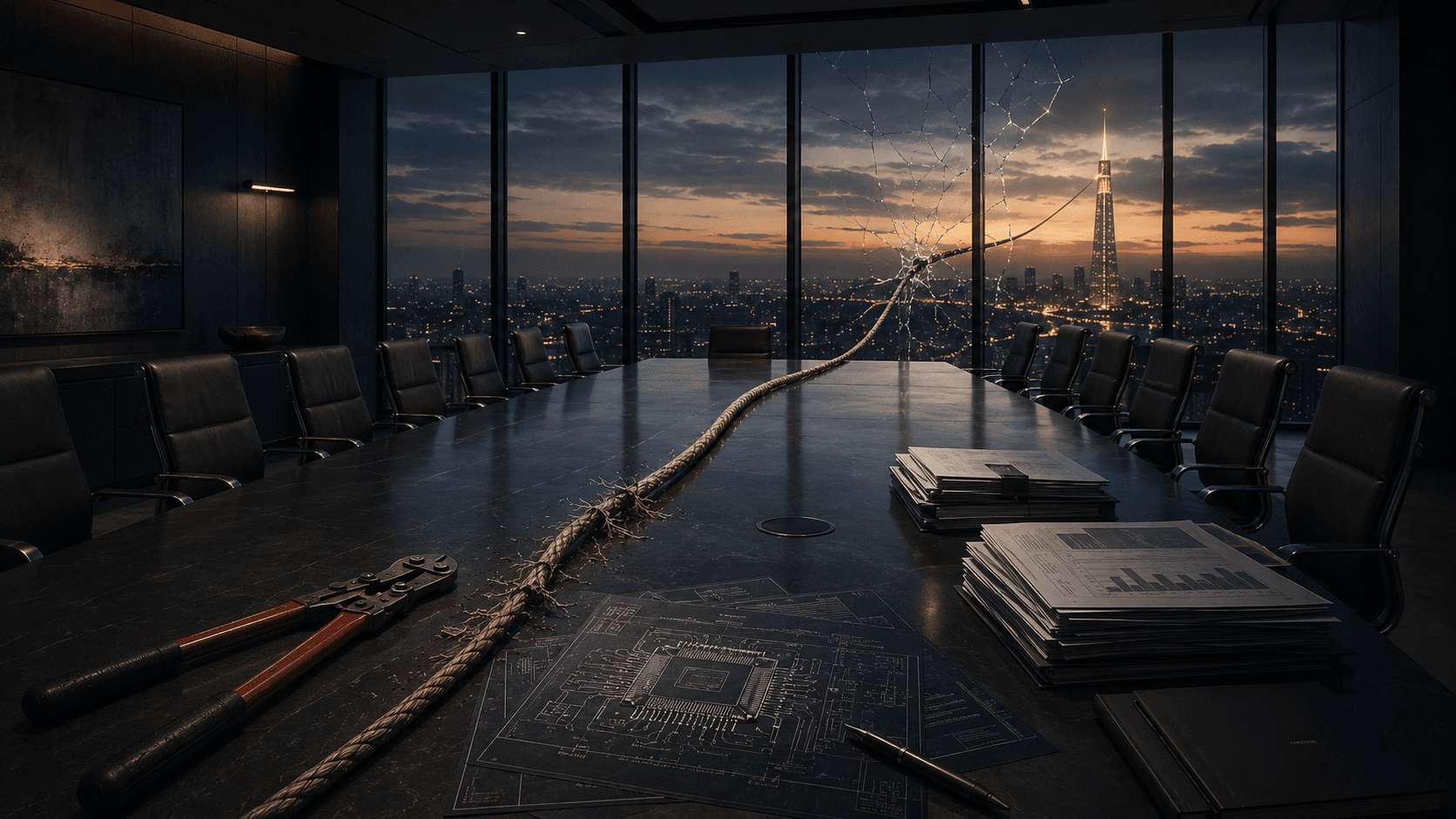
On June 7, Forbes published a sentence that would have sounded absurd in 2023: Microsoft is building its own AI stack to cut its dependence on OpenAI. The details read like a declaration of independence drafted by an engineering department — a family of in-house models under the MAI brand, including the MAI-Thinking-1 reasoning model; co-design with its own Maia and Cobalt silicon so the models run on chips Microsoft controls; an agent platform threaded through Windows, Azure, and GitHub. The stated logic, per Forbes, is room to negotiate on cost and the ability to set its own roadmap rather than wait on a partner. Strip the enterprise vocabulary off that sentence and look at what's underneath. A company is spending years and billions to get back the ability to make its own decisions — out of a relationship it entered voluntarily, because the relationship helped.
Because it did help. Rewind to 2023: Microsoft had committed billions to OpenAI and built Copilot on GPT models, and Forbes dates the dependence precisely there — the reliance "has defined its AI strategy since 2023." It was the rational move. The partner's brain was the best available; renting it put Microsoft years ahead of building its own; every quarter the integration deepened because every quarter it worked. We have written this exact paragraph before about a lonely person and a companion app, and the mechanism does not change with the market cap: the help is real, which is why you accept it, and the acceptance is daily, which is why it deepens, and a capability you adopted to move faster quietly becomes the thing your whole roadmap routes through. Nobody at Microsoft chose dependence. They chose help, repeatedly, and dependence is what repeated help compounds into.
We don't have to infer the fear, because it surfaced under oath. In May, testimony in the Musk–Altman trial revealed that Microsoft feared being too dependent on OpenAI — the company's own anxiety about its own cord, entered into the court record. And watch what the fear produced, because the sequence is recognizable to anyone who has tried to leave anything by halves. Since 2024, Microsoft has openly acknowledged that OpenAI is a competitor. It began allying with other model makers, including xAI, and offering their models through Azure. It tapped Anthropic's models for certain uses, then agreed to invest five billion dollars in Anthropic — the dependent party, hedging, diversifying its supply of the thing it could not yet quit. That is not a procurement strategy. That is what reaching for other hands looks like while the first cord is still attached.
“Entry was a press release. Exit is a chip fab, a five-billion-dollar hedge, and years of building your way out. The asymmetry between how easily the leaning starts and what it costs to stop — that is the whole subject.”
— Michael
Then there is the language the executives use, which gives the whole thing away. Microsoft's AI chief, Mustafa Suleyman, told The Verge there are three AI labs that matter and that he wants Microsoft to be the fourth — and he made a point of saying MAI-Thinking-1 was built without distillation, meaning it was not trained on another company's model. Sit with why that disclaimer needed saying: the company wants the world to know its new mind owes nothing to the old one. And in June, Suleyman said Microsoft had been "set free" from OpenAI to pursue superintelligence on its own. Set free. Companies do not say "set free" about vendor contracts. They say it about the other thing — the thing this site exists to name. Somewhere inside one of the largest companies on earth, the relationship with its AI supplier registered not as a line item but as a binding.
The honest objection is that this is anthropomorphism — that vendor-risk management and margin math are just business, and calling a cloud contract a tether is a metaphor stretched past its limit. Fine; throw out my words and keep theirs. Fear of dependence, in sworn testimony. "Set free," from the AI chief's own mouth. A partnership entered in months that is taking years and a custom-silicon roadmap to walk back. The asymmetry is the tell, and it is the same asymmetry every time: entry was a press release, and exit is a chip fab. Whatever name you give a relationship that is effortless to start, productive enough to lean on, and ruinously expensive to leave, you have described the thing precisely. We just spell it shorter.
Now scale it down, because that's the point of telling this story here. Microsoft had instruments most dependents never get: auditors to price the reliance, a board to fear it out loud, court discovery to put the fear on record, and the cash to build its way out — five billion for the hedge alone, years for the exit, and the project still isn't finished. The person with the companion app open at 2 a.m. has none of that apparatus. No quarterly review flags the dependence while it's forming. No rival brain can be retained for five billion dollars. The exit costs are paid in loneliness instead of capex, which is why nobody budgets for them. If untethering takes one of the deepest balance sheets on earth years of work and its own silicon, the advice to just use the app less is not a plan; it is a prayer. The mechanism is identical at every scale — real help, daily acceptance, structural dependence, expensive exit. Microsoft was tethered and can afford the untethering. Most people on the other end of a cord cannot. That is the whole reason the word exists.
A company with every instrument of self-awareness money can buy — auditors, a board, discovery — still needed years and its own silicon to start cutting one cord. The fear made it into sworn testimony. The relief made it into a headline: "set free." It was tethered. At that scale, it still works exactly the same way.
— Michael
whatever you do, take care of your shoes