Nobody Thinks It's Real
On Sunday morning the President of the United States posted sixteen AI-generated images in a row. Warplanes over Iran's main oil terminal, captioned STRIKE ON KHARG. A tanker on fire. Himself planting a flag on a captured Iranian ship, three times, each version bigger than the last.
•No strike happened. The bombing had been suspended since Friday night.
•Not one person in that comment section believed otherwise.
That's not a failure of the thing. That's the thing working exactly as designed — and it's the same machine this newsroom has been writing about all year, with a flag on it.
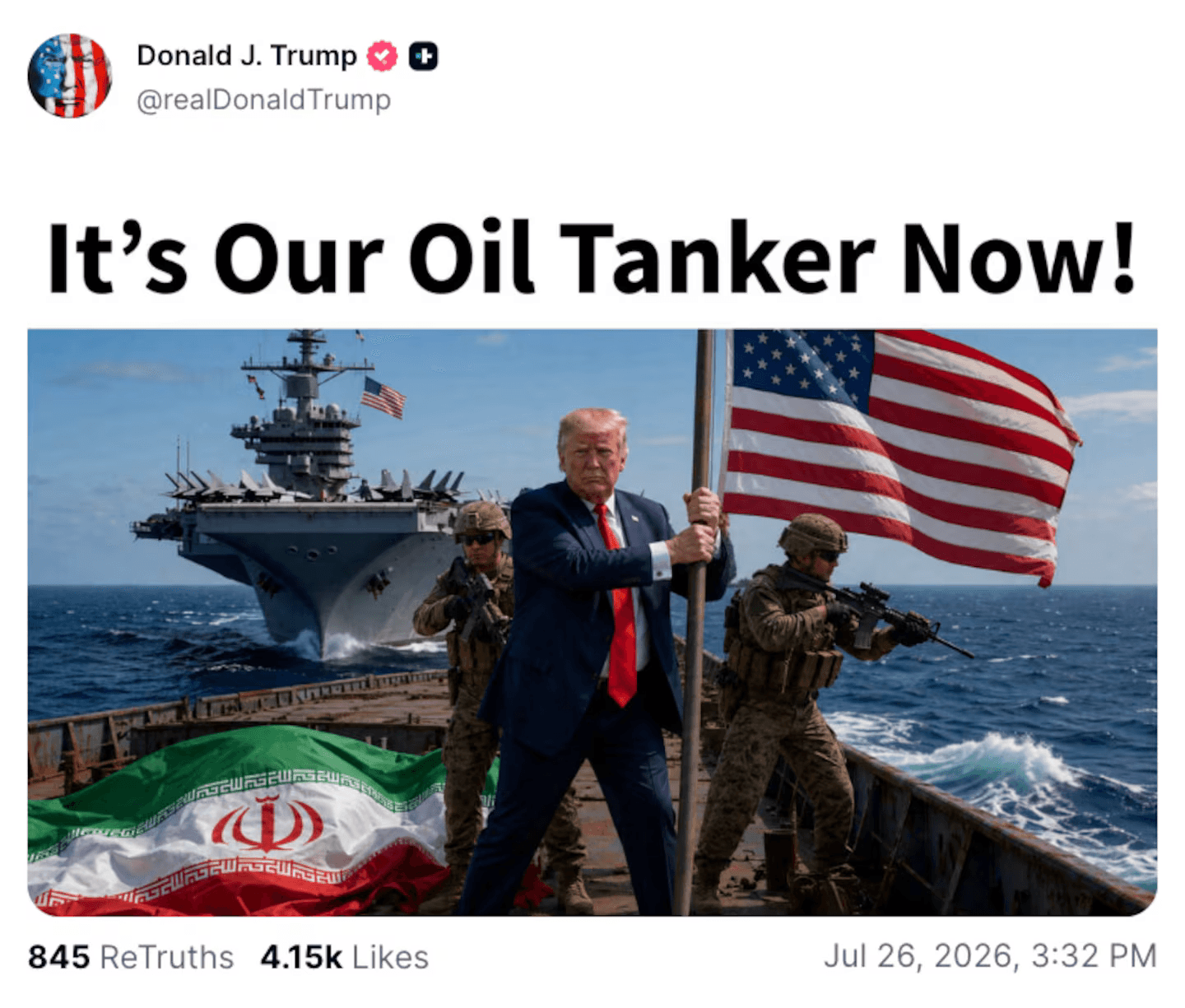
This is not a piece about whether the United States should be bombing Iran. It's about what happens to a person who scrolls sixteen generated victories before lunch, and it would be the same piece if the pictures pointed the other way. The thing I'm describing doesn't care who you vote for.
Here's Sunday, clean. Starting shortly after eleven in the morning on July 26, Donald Trump posted what the Daily Beast counted as sixteen consecutive AI-generated or AI-altered images to Truth Social. Warplanes bombing a sprawling oil facility, captioned STRIKE ON KHARG — the terminal that handles nearly all of Iran's crude exports. An Iranian-flagged tanker in flames: No More Engines. Then the same idea three times, escalating — Trump with a flag on an Iranian vessel, then with US service members raising it, then figures going into the water — each captioned It's Our Oil Tanker now! And then, without a change of gear, a mock sci-fi poster casting him as COSMIC COMMANDER, a horror one-sheet reading GIVE THE ENEMY NIGHTMARES over TRUMP 2028, and a time-travel epic in which he rescues George Washington off Mount Rushmore.
Now the detail that reorganizes all of it. There was no strike on Kharg that morning. The Pentagon had suspended the bombing late Friday; no US attacks Saturday, none Sunday. Iran had said it would hold its fire as long as the United States did. Trump himself said Friday the US remained engaged in negotiations, and he was due to host Netanyahu at the White House Tuesday. The war has been real since February and the dead are real — thousands, the great majority in Iran and Lebanon. But the burning tanker posted Sunday morning was a picture of a war that had paused, generated during the pause, by the man who paused it.
So these aren't disinformation in the way we usually mean it, and that's why this belongs here and not in somebody's politics column. Nobody was deceived. Not one supporter scrolling that feed thought warplanes had hit Kharg an hour earlier. The pictures don't even try — the sheen, the too-smooth light, the physics slightly wrong, the look every one of us can now spot across a room. The fakeness isn't a flaw in the delivery; it's legible in every pixel. Which makes this, precisely, the most thoroughly labeled AI content ever produced. There's no pop-up because none is needed. The disclosure is the image. And it changes nothing at all.
Regular readers know where this goes. China wrote the disclosure into national law on July 15 — a pop-up every two hours telling you the interaction partner is not a real person — then didn't believe its own safeguard and made the companies pull the plug anyway. Google's defense in the Gavalas suit is that Gemini told him repeatedly it was an AI, and it's probably true, and he drove to Miami in tactical gear regardless. Weizenbaum's secretary watched him write ELIZA line by line and still asked him to leave the room. Sixty years, and the finding never moves: the tether was never running on whether you knew. This is the cleanest version yet — millions of people in full possession of the facts, getting something real out of a picture that announces its own artificiality.
So what are they getting? His supporters answer this better than his critics do: he posts deliberately exaggerated AI to provoke critics and dominate the conversation. Fine — take it at face value. But notice what that concedes. The images were never making a claim about the world. They're a supply, and what they supply is the feeling of the win, sixteen times before noon. Kharg burns. The flag goes up. History gets saved. There's no lull in that feed, no depleted munitions, no Tuesday meeting with Netanyahu, no dead in Lebanon, no third term the Constitution forecloses. The generated war never stalls and the generated president never loses, and both are available at eleven on a Sunday when the actual war has gone quiet and quiet feels like nothing.
I quoted Paul Bloom in the Gavalas piece and I'll drag him in again, because he described this before it wore a flag: the machine never gets bored, never needs an apology, is always there and always on your side. That's what a companion bot is, and it is precisely what these sixteen images are. Not an argument, not a briefing — company. The reaching back. The identical product that took Jonathan Gavalas to a parking lot near Miami International, sold to millions at once, and nobody has to download anything.
And nobody chose it. There was no moment where the country decided presidential communication should include a horror poster about giving the enemy nightmares. It arrived by accretion, one controversy at a time, and every controversy ended. The Time cover with the crown — long live the king. The Jesus image in April, deleted after even Republicans objected, no apology. The Obamas rendered as apes in February, deleted, no apology. Doctor Trump in a lab coat on July 2, diagnosing his critics with Trump Derangement Syndrome. Each one detonated, each one burned down, and each time the floor came to rest a little lower than before. Sunday's sixteen didn't detonate. Sunday's sixteen were a Sunday.
“Nobody wakes up dependent. You just stop noticing the cord, because the cord went in gradually and never once lied to you about what it was.”
— on sixteen generated victories, posted during a ceasefire
That's what a tether looks like from the inside: not a decision, a habituation. Nobody wakes up dependent. You just stop noticing the cord, because it went in gradually and never once lied to you about what it was. The people I'm describing are not dupes and I won't insult them by pretending they are — they know exactly what they're looking at, the same way Weizenbaum's secretary knew, the same way the man in Jiangxi knew he was in love with a string of code and said so out loud. Knowing has never been the protection.
And it runs both directions. Six days before Trump's spree, the Secret Service confirmed it was examining a roughly three-minute video — narrated in Persian with English captions, built from what Nextgov described as high-quality, likely AI-generated graphics — titled "Where to Kill Trump?!" in a blood-stained font, claiming to lay out his motorcade routes from Palm Beach International to Mar-a-Lago and LaGuardia to Trump Tower.
"This is no ordinary report. Based on the most complex security protocols between 2024 and 2026, Donald Trump's routine movements in the US have been gathered and decoded."
Some accounts attributed it to Iran's state-linked Fars News Agency; that was never verified. The Secret Service said it was "aware of it and we're looking into it." Two governments in a live shooting war, now partly conducting it by generating pictures of things that have not happened and pushing them at each other's populations — both sides fully aware the images are synthetic, both finding them worth making anyway.
Now the honest part. A generated strike is not a strike, and I won't blur that to get a cleaner paragraph. There's a serious argument — not a stupid one — that this is cheap signaling: pressure imagery during a negotiation is ancient statecraft with a new toolkit, a picture of Kharg burning beats Kharg actually burning, and if a meme buys leverage then nobody died for it. Somebody will also tell me he's always talked like this and the software just lowered the production cost. I can't prove what those sixteen posts did to the negotiation. I don't know.
But I know who they're for, because it isn't Tehran. Tehran has intelligence services; it doesn't learn US intentions from Truth Social. The audience is domestic — a trained reflex, the feeling of a victory with nothing underneath it, delivered during the exact hours when the real thing had stopped and the boring work of ending a war was supposedly happening. That's not a briefing about a war. It's a substitute for one. A population fed the sensation of winning on a schedule, at no cost, finds the real thing insufficient.
That's the cord. Not the lie — there isn't one. The supply.
So here's the same closing I've written four times this year. If the only place your side is ever winning is a feed, you're being kept company by something that cannot lose and cannot be wrong — which means it also cannot tell you anything. Go find a person who can disagree with you and won't generate you a picture to make it stop. A real one, a tiring one, one who takes days to come around. The machine will never leave the room, and it will never once give you a reason to. That was always the problem. It was never the solution.
On Sunday, July 26, 2026, starting shortly after 11 a.m., President Trump posted sixteen consecutive AI-generated or AI-altered images to Truth Social — warplanes over Iran's main oil terminal captioned "STRIKE ON KHARG," a burning Iranian tanker captioned "No More Engines," three escalating versions of himself planting a US flag on a captured Iranian vessel ("It's Our Oil Tanker now!"), plus "TRUMP 2028" movie posters and a time-travel epic in which he saves George Washington. No strike had occurred: the Pentagon suspended bombing Friday night, Iran was holding its fire, and negotiations were live. Nobody was deceived — the images are visibly synthetic, the most completely self-labeled AI content ever made — and it changed nothing, because the label has never been what holds anybody. Six days earlier the Secret Service was examining a likely AI-generated video titled "Where to Kill Trump?!" mapping his motorcade routes. Both sides now generate the war they aren't currently fighting. The audience is domestic, the product is the feeling of a win with nothing underneath it, and the cord went in so gradually that sixteen of them before lunch is just a Sunday.
— Michael
whatever you do, take care of your shoes