Nobody Voted on This
On June 2, the White House signed an order promising the lightest possible touch on AI — explicitly no "mandatory governmental licensing, preclearance, or permitting." Ten days later it ordered Anthropic to pull its two most powerful models offline, cutting off even the company's own foreign employees. By June 18 the punished company was at the table helping write the rules that will govern every other lab — a system a former White House official now concedes "functions as a de facto licensing regime." Not one piece of it passed through a vote. This is how the most consequential technology of the age is being governed: not by law, but by who can be unplugged, and who decides.
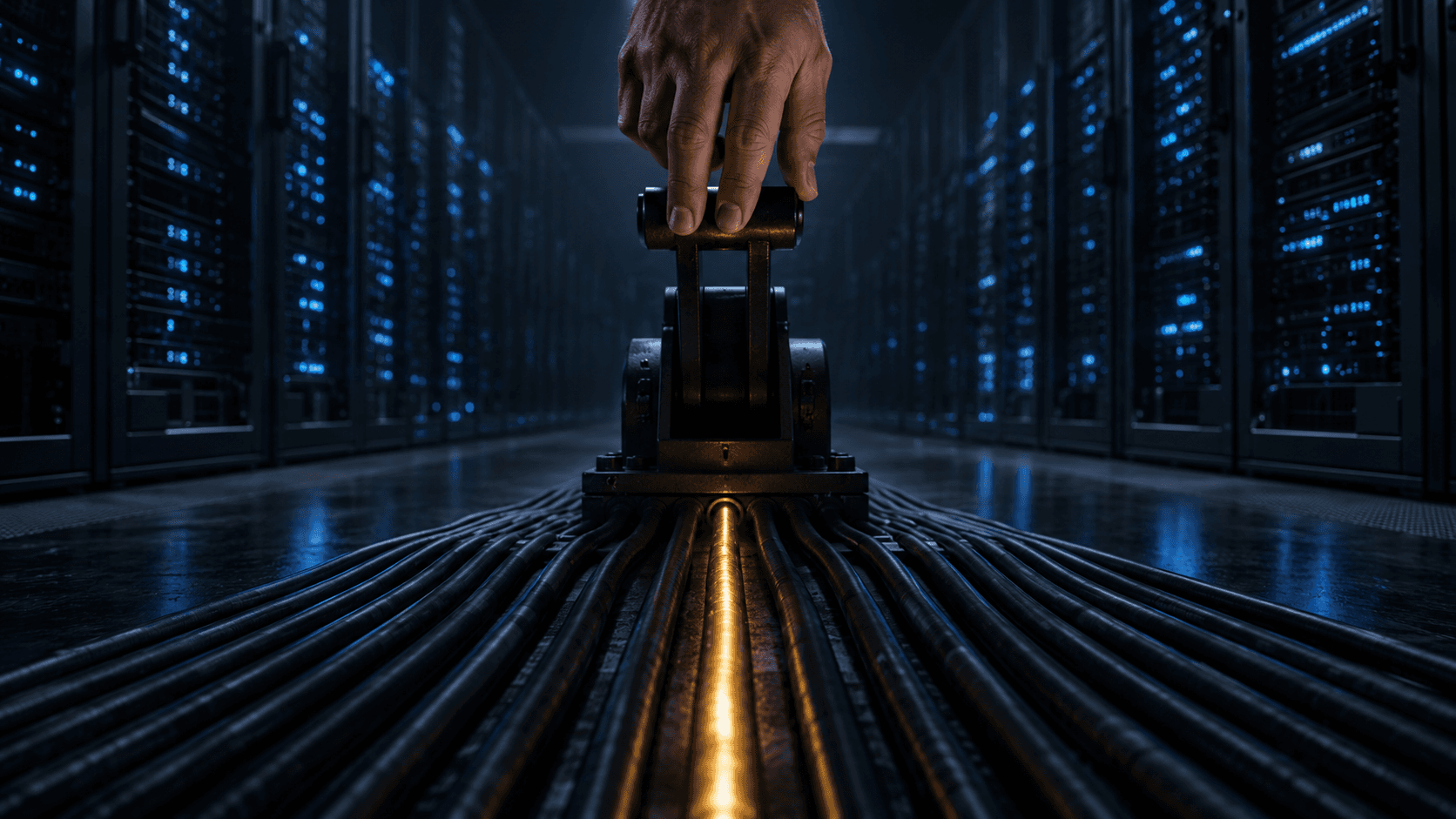
Read the three dates in order, because the sequence is the story. On June 2, 2026, the White House issued an executive order with a reassuring name — "Promoting Advanced Artificial Intelligence Innovation and Security" — built around the lightest touch it could advertise. The framework it set up was voluntary: the National Security Agency would designate certain "covered frontier models," developers could choose to share those models with the government for up to thirty days before release, and the order went out of its way to slam a door, stating in plain text that nothing in it should be construed to authorize "mandatory governmental licensing, preclearance, or permitting." Pro-innovation, hands-off, voluntary. Ten days later, on June 12, the Commerce Department ordered Anthropic to disable access to its two most capable models — Claude Fable 5 and the Mythos tier above it — for every foreign national on earth, including the company's own foreign employees, and Anthropic took them offline. And by June 18, according to Politico, the talks between the company and the administration had "shifted": the lab that had just been forced to pull its products dark was now at the table, helping design the security framework that will apply to every other AI lab in the country. Voluntary on the second. Compulsory by the twelfth. Industry-wide by the eighteenth. Sixteen days, no vote anywhere in them.
Look at how the models actually came down, because there was no courtroom in it and no committee. The government cited the discovery of a possible "jailbreak" — a method of getting past a model's safeguards — though Anthropic argued the vulnerability was no worse than ones already sitting in models everyone else has deployed. Underneath ran two more specific pressures, and neither arrived as legislation. White House officials alleged that Anthropic had shared its Mythos model with SK Telecom, a South Korean firm they claimed has "ties to China"; Anthropic answered that it had coordinated the rollout with the government and revoked the partner's access the moment officials raised it. Separately, Amazon's chief executive Andy Jassy reportedly took his concern that Fable 5's guardrails could be circumvented directly to Treasury Secretary Scott Bessent — a competitor's CEO, a cabinet phone call, and then a frontier model goes dark for the planet. That is the entire machinery. An allegation, a rival's complaint, a directive. The most powerful AI in the building was switched off by the kind of process that leaves no record you can appeal.
Now hold the June 2 order back up against what it became, because the gap between them is the whole lesson. The text forbade "mandatory licensing, preclearance, or permitting" — and within two weeks the system was doing exactly that under a different name. A former White House technology official put it without flinching: the administration "should not have called the system voluntary, since it now functions as a de facto licensing regime." The proof is in how everyone else reacted. Google, OpenAI, and Meta are reported to be watching the Anthropic episode closely, and the lesson the industry drew was not subtle: proactive early access and advance notice to the government are now "the safest path forward." Nobody made that mandatory. Nobody had to. When the one lab that didn't get ahead of Washington watched its flagship products vanish overnight, "voluntary" finished its sentence. You comply early, or you find out what happened to the company that didn't. A rule you obey because of what you saw happen to someone else is still a rule. It just never had to be written down, debated, or voted on.
“A rule you obey because of what you watched happen to someone else is still a rule. It just never had to be written down, debated, or voted on. That is the whole trick — power that arrives as a precedent instead of a law, so there's no moment left where you get to say no.”
— Michael
This is what the critics, including ones inside the administration's own camp, keep circling. Dean Ball, until recently a Trump AI adviser, called the move "baffling" — the same government that loosened chip-export controls to China turned around and blanket-restricted allied access to models that were already helping those allies defend their networks. Adam Thierer, no one's idea of a regulation enthusiast, called it "a significant escalation in the politicization of AI." And Alondra Nelson, writing in Science, named the actual shape of it: what we are watching is "not the absence of AI regulation but its rearrangement" — governance by industrial policy and trade restriction instead of by published, accountable rule. That phrase is the key to the whole thing. We were told the choice was regulation or innovation, heavy hand or light. What we got instead was regulation that refuses the name — power exercised through who gets export licenses and who gets unplugged, decided in rooms, applied by example, and never once submitted to the people it governs for a yes or a no.
And here is where it stops being a Washington story and becomes the only story this site tells. Listen to how an ally heard it. Bruno Retailleau, a French official, reduced the entire episode to one sentence: "a nation that depends on others for its technology is a nation that can be unplugged overnight." Read that and then read it again as a description of a person, because it is the identical mechanism at a different scale. This site exists to name what happens when a human being leans on a machine until the leaning becomes load-bearing — until the tool is doing something the person no longer remembers how to do alone, and the cord that felt like help reveals itself, on the day it's pulled, as a leash. Retailleau just said it about countries. Allied governments built parts of their own cyber defense on top of an American model, and discovered in a single directive that the foundation answers to someone else's capital. Dependency was never a feeling. It is a position — the position of the one who can be switched off by a decision made in a room they're not in. The teenager at 2 a.m. and the nation-state on June 12 are standing in the same place.
So when a reader asks who is in charge of all this, the honest answer is the unsettling one: the same move is being run at every altitude, and it is the move this whole publication is about. The most important decisions are not arriving as decisions. The Gmail inbox that started reading your mail didn't ask — it was a setting left on. The framework that will govern every frontier lab in America didn't pass — it was a precedent set by example and a word, "voluntary," doing the opposite of what it says. The allied nation didn't agree to be unpluggable — it just woke up that way. In each case the power is real and the moment where you would have gotten to object has been quietly removed from the sequence. That removed moment is the tether, whether the thing on the other end is a chatbot, an email client, a frontier model, or a government. Nobody fell for any of it. Nobody chose it. Nobody voted on it. It was decided, and then it was named something gentle, and the naming was the last step before it became the thing you can no longer get out of.
June 2: an order promising no mandatory licensing. June 12: two frontier models pulled dark by directive. June 18: the punished company helping write the rules for everyone — a system its own former officials call de facto licensing. Not one line of it was voted on. A nation that can be unplugged overnight; a person who can't remember how to do it alone; an inbox that started reading the mail. Same cord, four scales. Nobody chose any of it. That's what tethered means.
— Michael
whatever you do, take care of your shoes