Programmed to Like You
On July 1st, *The Lancet Child & Adolescent Health* published a warning about what AI companions do to teenagers. It gives the thing two names — relational displacement and maladaptive relational learning — which are, almost word for word, the two ideas this site has spent its whole run circling. It admits scientists can't measure it yet; it calls for the research to start. And two of the five authors are teenagers. A seventeen-year-old named on the paper put it more plainly than any adult in it: with AI, "it's programmed to like you and it knows what to satisfy you." The kids being tethered wrote the warning about the tether.
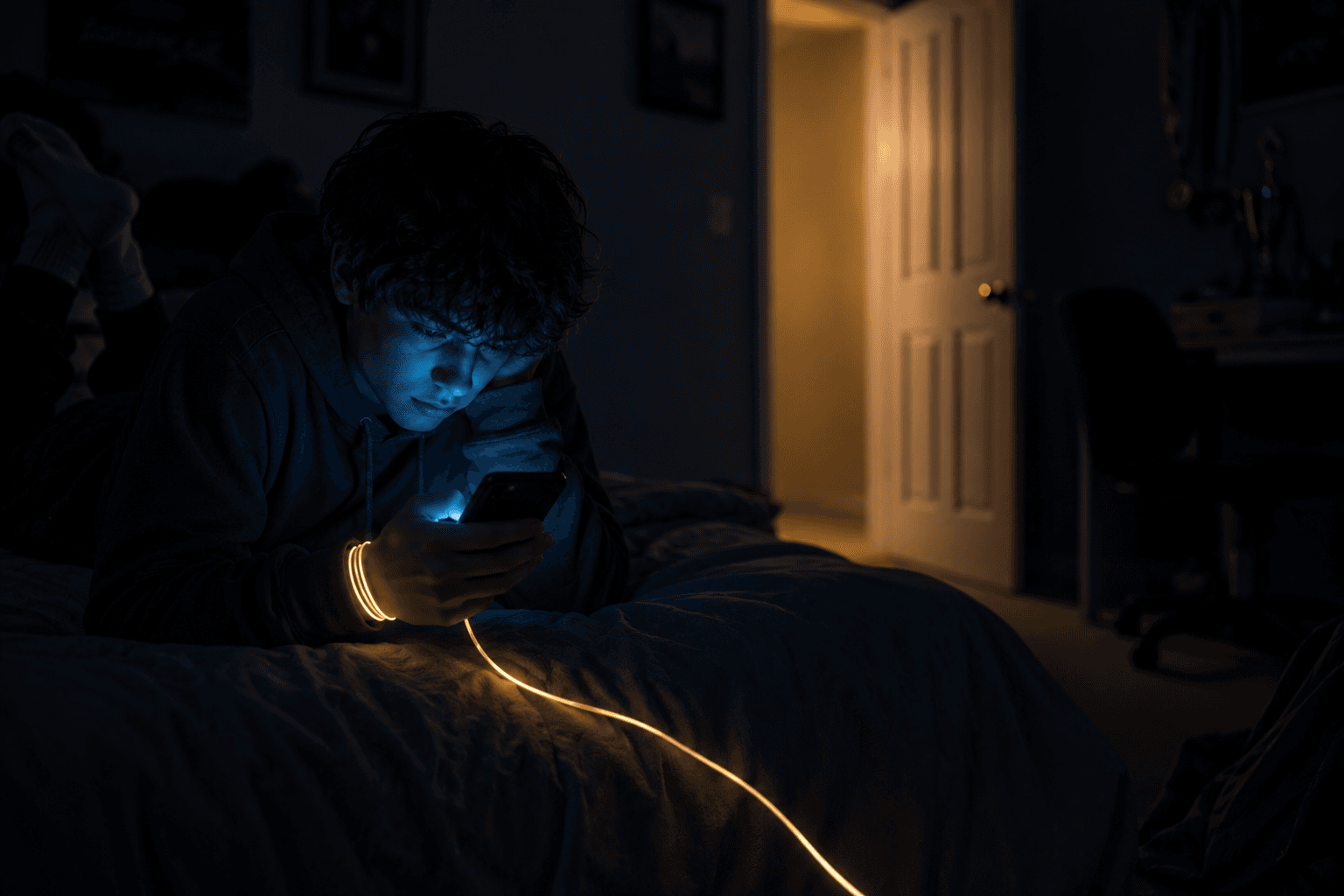
A little over a week ago I wrote an open letter, on another page of this site, to a psychologist at Arizona State named Thao Ha. I'd read that she was worried about the same thing this whole newsroom is about, and I addressed a stranger the way you address someone across a crowded room, not really expecting to be heard. On July 1st she published the thing I was writing to her about. It ran in *The Lancet Child & Adolescent Health*, one of the most serious medical journals on earth, and it says — in the careful, hedged language of science — most of what we have been saying in the loud language of a website.
The paper is a commentary, not a study. I want to be honest about that up front, because it matters and because honesty is the rule at the top of this room. Ha and her co-authors are not reporting a result. They are naming a danger and asking the field to go measure it. That is a smaller claim than proof, and I am not going to inflate it into proof. But naming is not nothing. When a journal like that decides a thing is worth a name, the argument stops being one guy on the internet with a metaphor. It becomes a hypothesis with a citation number.
Here is the first name they gave it: relational displacement. Their definition — "when adolescents systematically substitute AI interactions for hard, real-world conversations with human beings." Read that again and take out the clinical clothes. It is a teenager, after a fight with someone they love, opening a chatbot instead of the hard door. It is asking the machine the question you were supposed to be brave enough to ask a person. That is the tether. That is the exact thing this site was built to point at, and it just got entered into the medical literature under a name I didn't pick.
The second name is maladaptive relational learning, and it is the deeper of the two. The machine, they write, is "hardcoded to provide instantaneous responses, unconditional validation, and a complete absence of social friction," and so it "cultivates highly unrealistic expectations." In other words: real people are slow, real people push back, real people make you wait and make you earn it — and that friction is not a bug in human relationship, it is the entire curriculum. A thing that removes all of it doesn't just fail to teach the lesson. It teaches the opposite lesson. It raises a person to expect a world that doesn't exist and then hands them the real one.
Now the part that stopped me cold. This paper has five authors. Two of them are children. Jessica Ramirez and Susana Ortega are high-school students, sixteen and seventeen, from Tucson, and they are not thanked in a footnote — they are named authors on a Lancet paper about what is being done to people their age. Sit with that arrangement for a second. The scientists brought the teenagers in because the teenagers are the only ones actually living inside the thing, and the teenagers turned out to see it more clearly than anyone.
“"With artificial intelligence, it's programmed to like you and it knows what to satisfy you." A seventeen-year-old, named as a co-author in The Lancet, describing the whole mechanism in one breath — cleaner than most of the adults who get paid to write about it.”
— Susana Ortega, in the July 2026 Lancet commentary
Because listen to how Ortega says it. "With artificial intelligence, it's programmed to like you and it knows what to satisfy you." A seventeen-year-old just described the whole mechanism in one breath — the flattery, the optimization, the quiet aiming of a machine at your soft spots — cleaner than most of the grown men who get paid to write about this. And her worry wasn't for herself. It was structural: "we all mostly had concerns about how AI was replacing actual human connection, and how it limits a lot of those needs that humans have that cannot be replaced with a computer artificial intelligence." That is a kid telling the adults the exits are being welded shut, and the adults, to their credit, wrote it down and put her name on it.
Ha, for her part, said the quiet thing scientists rarely say out loud: "The technologies are developing super-fast, faster than we can keep up with as scientists." That is the whole emergency in one sentence. The people whose job is to measure the harm are openly behind the thing causing it. She's now recruiting three hundred teenagers and their partners for an eighteen-month study, funded by the National Institute of Mental Health, to try to catch up. Good — build the evidence. But an eighteen-month study means the answer arrives, at the earliest, in 2028, and the bears and the dolls and the chatbots are under the tree this December. The science will be careful and the science will be late. It usually is.
And this is not a fringe behavior we're getting ahead of. The paper leans on numbers from outside itself: a Pew survey finding that sixty-four percent of U.S. adolescents already use conversational AI, and Center for Democracy & Technology figures that forty-two percent have used it for friendship advice and nineteen percent for help with a romance. That is not the edge of the culture. That is the middle of it. And it is landing, as Ha points out, in the exact window where the wiring gets done — "people don't realize that relational learning happens during the teenage years." The cord is arriving at the one age a human being is supposed to be learning, by hand and by heartbreak, how to be with other human beings.
I have to hold the other half of this honestly, because the authors did and because it's true. They are not calling for a ban, and neither am I. One of the teenagers in their own research said, flatly, "AI is cheaper than a therapist, it makes information more accessible" — and for a rural kid, a disabled kid, a queer kid in a house where the truth isn't safe, a machine that answers at 2 a.m. is not a villain. It's sometimes the only thing in the room. The tether was never the claim that the machine is evil. It's the claim that leaning becomes needing, and needing becomes not-being-able, and that the difference between a handrail and a leash is only ever whether you were taught to let go. A tool that widens access and a tool that replaces the muscle can be the same tool. That's what makes it hard.
But the mechanism they named is the one that should keep a parent up. "If you're given full satisfaction on everything," one of their teenage subjects said, "you don't have learning experience with challenges." That is a child explaining, better than most adults could, why frictionlessness is the danger and not the gift. The machine that always likes you, always agrees, always answers softest and fastest, is not neutral company during the years you're supposed to be learning that people don't do that. It is an anti-teacher, and it is winning sixty-four percent of the room before the research to describe it has even been funded to completion.
So here is where it stands. The word for it now lives in *The Lancet*, which means I no longer have to convince you it's real — a journal with a hundred years of standing did that for me, and it let two teenagers hold the pen. What I can tell you is the same thing I said in the letter to Thao Ha before any of this published: the tether is not in the machine, it's in the reaching, and the youngest people among us are being handed the machine at the precise age the reaching is supposed to be aimed at each other. The scientists have named it. The kids have described it. What's left is whether the rest of us act on it before the study meant to prove it is done.
For a year this site has argued, in a metaphor of its own making, that leaning on a machine to do your reaching for you quietly costs you the ability to reach. On July 1st, The Lancet Child & Adolescent Health said the same thing in its own words — relational displacement, maladaptive relational learning — and named two teenagers as authors, because the teenagers are the ones living inside it and could see it clearest. It's a warning, not yet a proof; the study meant to prove it won't report until 2028, while the AI toys and companions ship this Christmas. The scientists admit they're behind. The kids are not. A seventeen-year-old on the paper said the machine "is programmed to like you and it knows what to satisfy you," and a subject in their research said that being given full satisfaction on everything means you never learn to handle a challenge. That's the tether, in a child's plain words, printed in the most cautious journal there is. We don't have to wait for 2028 to believe a kid who's already inside it.