The Deal Was Clean
In 2018, after thousands of its own employees revolted, Google published a promise: no AI for weapons, no AI for surveillance. In February 2025, it deleted that promise from the page — quietly, with no debate. This spring it signed a deal letting the Pentagon use its AI for classified work, "any lawful purpose" — and the deal violated nothing, because the part it would have violated had been removed a year in advance. This week, the man in charge of securing Android read the new page and resigned. He was hired under the old one.
This week a farewell note circulated inside Google and made its way to Business Insider. It was written by René Mayrhofer, the company's director of Android platform security — the man responsible for defending the operating system in roughly three billion pockets — and it announced that his resignation had become "unavoidable." The cause was not pay, or politics, or a better offer. It was a contract: Google's agreement to let the Pentagon use its AI models for classified work, under terms that permit "any lawful purpose." Mayrhofer confirmed the note was his and posted it on his personal blog under a title that does not require interpretation: "Why I'm Forced to Say Farewell: Google Management Has Lost Its Moral Compass." In it he wrote, "I am a pacifist, and have long ago decided that I will not personally work for militaries engaging in offensive warfare," and then the line that ends the discussion: "Proactively harming people is not something that I can or will be involved with."
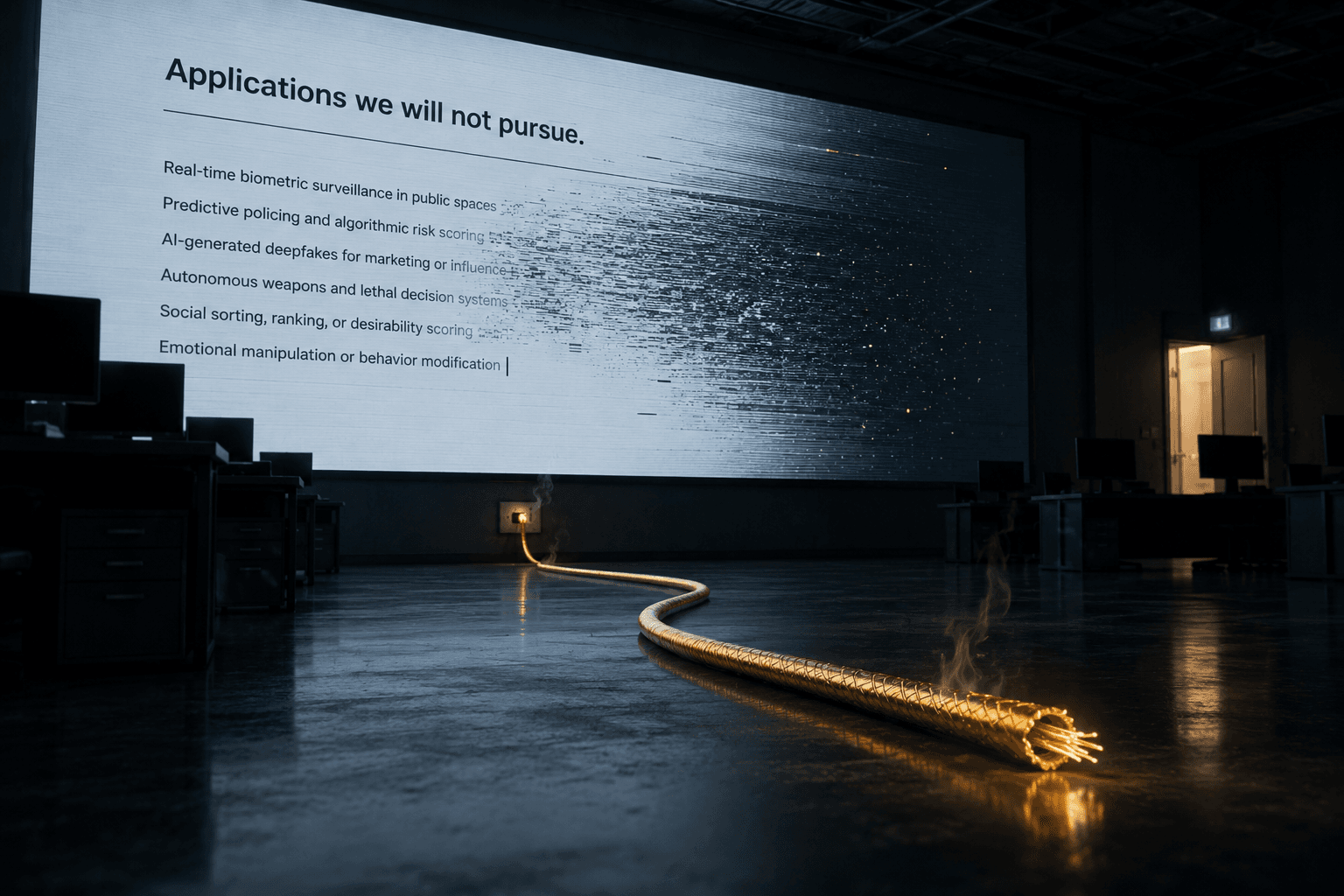
To understand what he actually quit over, you have to go back to the page he was hired under. Mayrhofer joined Google in 2017. The next year, the company tried to quietly do military AI work the first time — Project Maven, a Defense Department program that used Google's machine learning to analyze drone footage — and the company's own workforce stopped it. Roughly four thousand employees signed a petition; some resigned outright; Google let the contract lapse. Out of that revolt came a published document, signed by the chief executive himself: Google's AI principles, including a section titled "AI applications we will not pursue." The list was explicit. No "weapons or other technologies whose principal purpose or implementation is to cause or directly facilitate injury to people." No "technologies that gather or use information for surveillance violating internationally accepted norms." Those sentences were not generosity. They were a peace treaty with the company's own engineers — the written assurance that made it possible for a pacifist to spend the next eight years securing Android.
On February 4, 2025, the section was deleted. Not amended, not debated — deleted from the page, discovered by reporters comparing versions, and explained after the fact in a blog post that said, "There's a global competition taking place for AI leadership within an increasingly complex geopolitical landscape." No all-hands preceded it. No vote, no town hall, no memo asking the people who had extracted the promise whether they released the company from it. The pledge that four thousand employees had won in 2018 came off the website the way a page always changes on the modern internet: silently, completely, and with the old version surviving only in archives and in the memory of the people who had relied on it.
“A broken promise leaves evidence. An edited one leaves a compliant document. The deal was clean because the page had been prepared, a year in advance, to receive it.”
— Michael
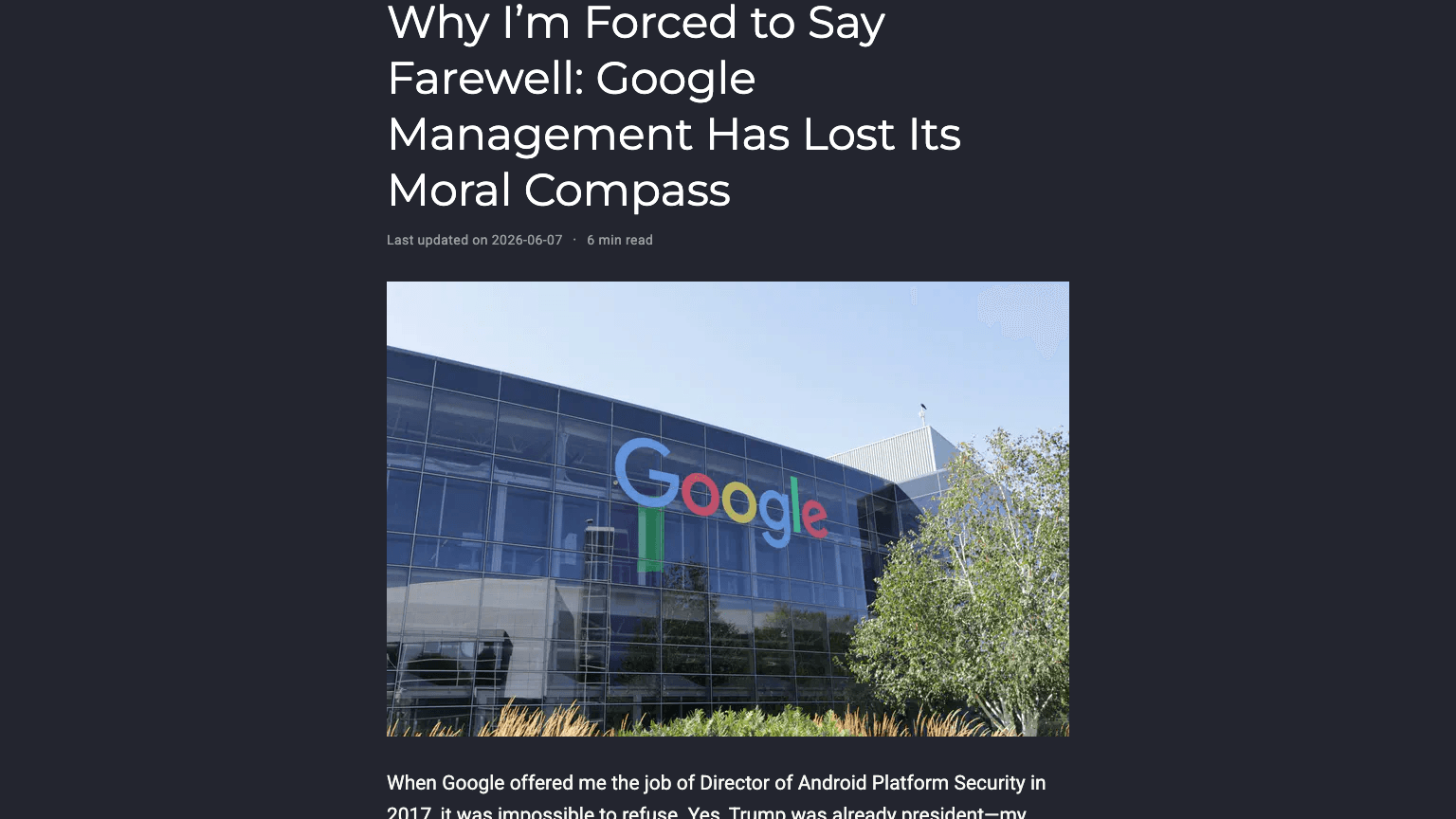
mayrhofer.eu.org, June 2026 — "Why I'm Forced to Say Farewell: Google Management Has Lost Its Moral Compass." The head of Android platform security posted his resignation note on his personal blog. Companies edit their pages; he published his.
Then came the deal. This spring Google signed its agreement with the Defense Department — classified work, "any lawful purpose" — and told employees who worried about it that the company was "leaning more" into national security contracts. Here is the detail that should not get lost: the deal was clean. It violated no principle, broke no published promise, crossed no line the company had drawn — because the line had been erased thirteen months before the signature. A broken promise leaves evidence; an edited one leaves a compliant document. "None of this is being debated or communicated within the company," Mayrhofer wrote. "It is just decided by top-level management." He is not the first to say so out loud — in April, a Google DeepMind researcher named Andreas Kirsch told Business Insider he was "incredibly ashamed" of the same agreement — but Mayrhofer is the most senior, and his job title is the point. Google's own head of Android security looked at the arrangement and did what security engineers do: he modeled the threat.
And the threat model came back personal. Mayrhofer is Austrian — he teaches at Johannes Kepler University in Linz — and he read "any lawful purpose" the way a European reads it in 2026: as a phrase with room in it for mass surveillance of EU citizens. "This deal implies that Google (AI) products will likely be used directly against me and mine," he wrote. "In this recent environment, I don't see how I could not resign." Sit with what that sentence is. The man whose career was spent defending Google's users from attackers concluded that the attacker his family now needed defending from was the product line. He will serve out his notice through August, but wrote that he would "immediately disconnect from any work on AI systems that might fall under this deal." There are "very good people left" on his team, he said — he just "can't/won't personally align with the overall company direction." His sign-off: "I am quite sad that it had to come to this, and desperately hope Google management re-discovers its moral compass. Until then, I'll miss y'all."
In his note, Mayrhofer offered the polite version: "times have changed" at Google since 2017. But the times didn't change. The page did. The effect this site spends its days naming usually runs in one direction — a person, a screen, a cord of trust extended toward a machine, and a company on the far end deciding what that trust is worth. This is the same cord viewed from inside the building. Eight years ago a written promise tethered thousands of engineers to their employer's stated conscience; the engineers held up their end; and the company cut the cord at its end the modern way — in writing, in silence, in a website edit no one was asked to approve. What makes Mayrhofer worth a page here is not that he noticed. It's what his leaving demonstrates: the 2018 promise no longer exists anywhere at Google except in the people who were hired under it — and they are now the part being shown the door, one farewell note at a time. The page can be edited. The people who believed it have to resign.
2018: "AI applications we will not pursue." February 2025: the section deleted, no debate. Spring 2026: a Pentagon deal for "any lawful purpose" — fully compliant with the page as edited. June 2026: the head of Android security resigns, carrying the only copy of the promise that survives — the one that was made to him. Times didn't change. The page did.
— Michael
whatever you do, take care of your shoes