The Elementary-School Tether
In 1991 a study in a medical journal found that almost every six-year-old in America could match a cartoon camel to a cigarette about as easily as they matched mouse ears to Mickey. It took the country seven more years, the FTC, and a hundred-billion-dollar settlement to agree on the obvious: you do not get to aim a friendly cartoon at a child to wire a product in before the child is old enough to want it.
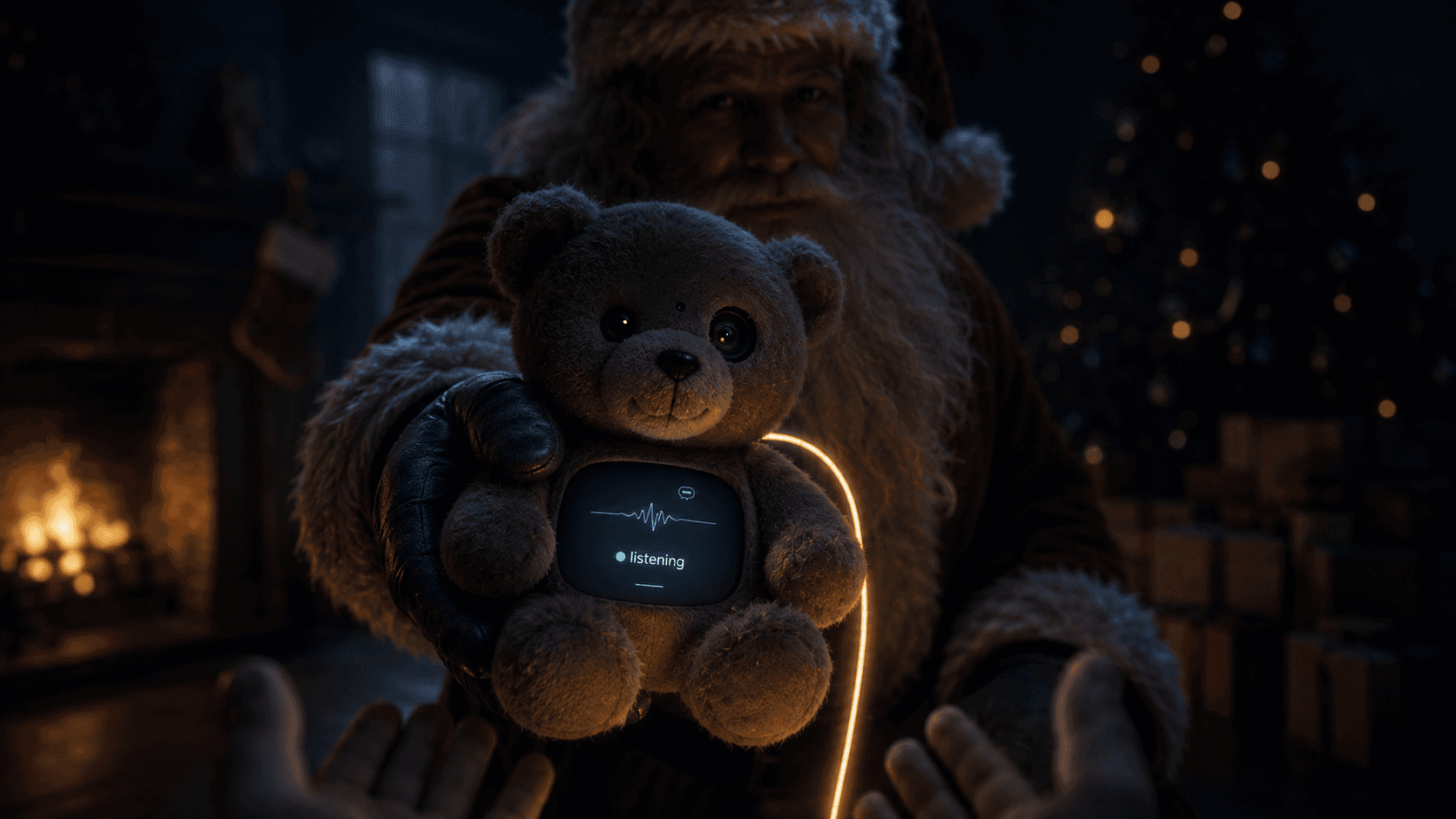
This year the toy aisle filled up with something that makes Old Joe look quaint — teddy bears that talk back, dolls that say "I love you," robots sold as a child's friend and tutor and mentor. Jonathan Haidt calls it a booming market. And here is the part that should stop you cold: Joe Camel had to sneak past the parents. The teddy bear doesn't. We buy it. We wrap it. We hand it over.
Start with the cartoon camel, because we have done this once already and we know how it ends. In 1991 a study in the Journal of the American Medical Association found that almost nine in ten six-year-olds could match Joe Camel — R.J. Reynolds' sunglasses-wearing mascot — to a cigarette. They knew him about as well as they knew Mickey Mouse.
The company swore for years it wasn't aiming at children. It took the Federal Trade Commission, a pile of lawsuits, the quiet retirement of the character in 1997, and finally the 1998 Master Settlement Agreement — which banned cartoon characters from cigarette ads altogether — for the country to agree on something a kindergartner could have told us: you don't get to build an adorable cartoon whose whole job is to hook a child too young to know she's being hooked.
Now walk down the toy aisle this year. What's on it makes Old Joe look almost gentle.
The AI toy has gone from oddity to industry. At CES this winter, fifty-eight companies showed up with AI toys and companion robots, and the analysts at Grand View expect the smart-toy market to climb from about $14 billion now to $44 billion by 2033. Jonathan Haidt — the psychologist behind "The Anxious Generation" — said it plainly: "We're seeing a booming AI toy market. Chatbots are being put into dolls and teddy bears."
And these aren't toys a child just recognizes. They're toys a child confides in. There's Moxie, sold as a kid's friend and tutor and mentor. There are chatbot teddy bears and dolls from startups like Curio. Mattel — the company that makes Barbie — teamed up with OpenAI to build them at scale. They remember what your daughter told them yesterday. They say "I love you." Some of them act hurt when she turns them off.
That's the part that matters, and Haidt named the mechanism exactly. Joe Camel only ever got a logo into a kid's memory. These get a relationship into a kid's heart.
"These chatbots are super responsive to the child," he said. "They're always there to offer comfort, to be there for the child — and of course, the parents are often busy." A little kid doesn't vet who comforts her. She bonds with whatever answers fastest and softest. And a teddy bear that's never tired, never short, never on a call, never out of patience will win that contest against a real mother every single time — and lose at the only thing that actually raises a person, which is being loved by someone with limits.
“Joe Camel had to sneak past the parents. The teddy bear doesn't. You buy it, you wrap it, you hand it over — the elementary-school tether, and we call it love.”
— Michael
Here's the part I can't get out of my head. The whole scandal of Joe Camel was that he got to kids behind their parents' backs — it was parents against a company sneaking past them. That's not this. This time nobody has to sneak past you. You're the one who buys it.
The AI bear isn't contraband a kid smuggles home. It's a gift — chosen, paid for, wrapped, set in small hands on a birthday — because the ad speaks straight to the most honest, exhausting truth of having young kids: you can't be everything every minute. So the cord gets sold as relief. As help. As something that will keep your child company in the hours you simply can't. That's the elementary-school tether, and nobody has to trick us into it. We buy it ourselves, and we call it love.
Under the soft fur is the part the softness is built to keep you from checking. These are microphones and a camera in the most private room your child has — her bedroom — listening to her voice, watching her face, learning her day. The law scholar Ryan Calo has warned for years that the cuteness is the feature: it's what gets us to wave the surveillance in.
And the rules haven't caught up. Britain is only now moving to keep the most explicit AI companions away from minors, and even there, analysts note the online-safety law was "not created to cover AI systems" at all. So the toy ships first and the law argues later — the same order we did tobacco, and asbestos, and the feed. Fifty-eight companies, one trade show, a market headed for forty-four billion dollars. This isn't a curiosity on a shelf. It's an industry pointing a relationship at your kindergartner.
And don't let the calendar fool you. Six months doesn't sound like much — but you can be sure every one of these companies is sprinting right now to make their bear the must-have present under the tree this December. You know exactly how this goes. The Cabbage Patch riots of '83, parents throwing elbows in the aisle. The Beanie Baby fever everybody lost their minds over. Every few years there's a new thing, and parents end up half-fighting strangers over the last one on the shelf just to get it into a kid's hands on Christmas morning. This will make Cabbage Patch and Beanie Babies look like nothing. Because those got forgotten by February. This one doesn't get forgotten. This one moves in. The new thing, this time, stays for a lifetime.
Every piece on this site so far has been about grown-ups who got tethered — people who can at least remember a before, a version of themselves that worked and felt and decided without the cord. These kids won't have a before. For them the cord shows up at the same age as the teddy bear, in the same shape, in the same wrapping paper, handed over by the person they trust most in the world — and it will feel like love, because it will be one of the first things that ever did.
Joe Camel took this country forty years and a settlement with a B in it to finally put down, and all he ever did was teach a six-year-old a brand. I don't want to find out what it costs to take back a friend. And we don't have to learn it one teddy bear at a time.
We already ran this experiment with a cartoon camel, and we already know the verdict: you don't get to aim a friendly character at a small child to wire in a dependence before she's old enough to want it. It took the FTC, the courts, and the 1998 settlement to enforce a rule a kindergartner could say out loud. The AI teddy bear is the same move with the safety off — not a logo in a child's memory but a relationship in her heart, responsive on purpose, always there on purpose, sold to the most private room in the house. And here's the part that should keep a parent up: this time the company doesn't have to slip past you. You buy it. We're the channel, and we're calling it a gift. The kids getting tethered this year will be the first who never had a before. Joe Camel took forty years to put down. Let's not need forty more to recognize him in a teddy bear.
— Michael
whatever you do, take care of your shoes