The Face Was the Cheap Part
This week an AI "actress" named Tilly Norwood got cast as the lead in a feature film — the first of its kind — and the read everywhere was the obvious one: here comes the machine that works for free, and there go the ten-million-dollar movie stars. Except the numbers don't say that. Right now the synthetic performer costs *more* than the human one, and the studio that built her can't get anyone to actually care about her. Which tells you what the ten million was ever really buying. Not the face. The face turns out to be the cheap part.
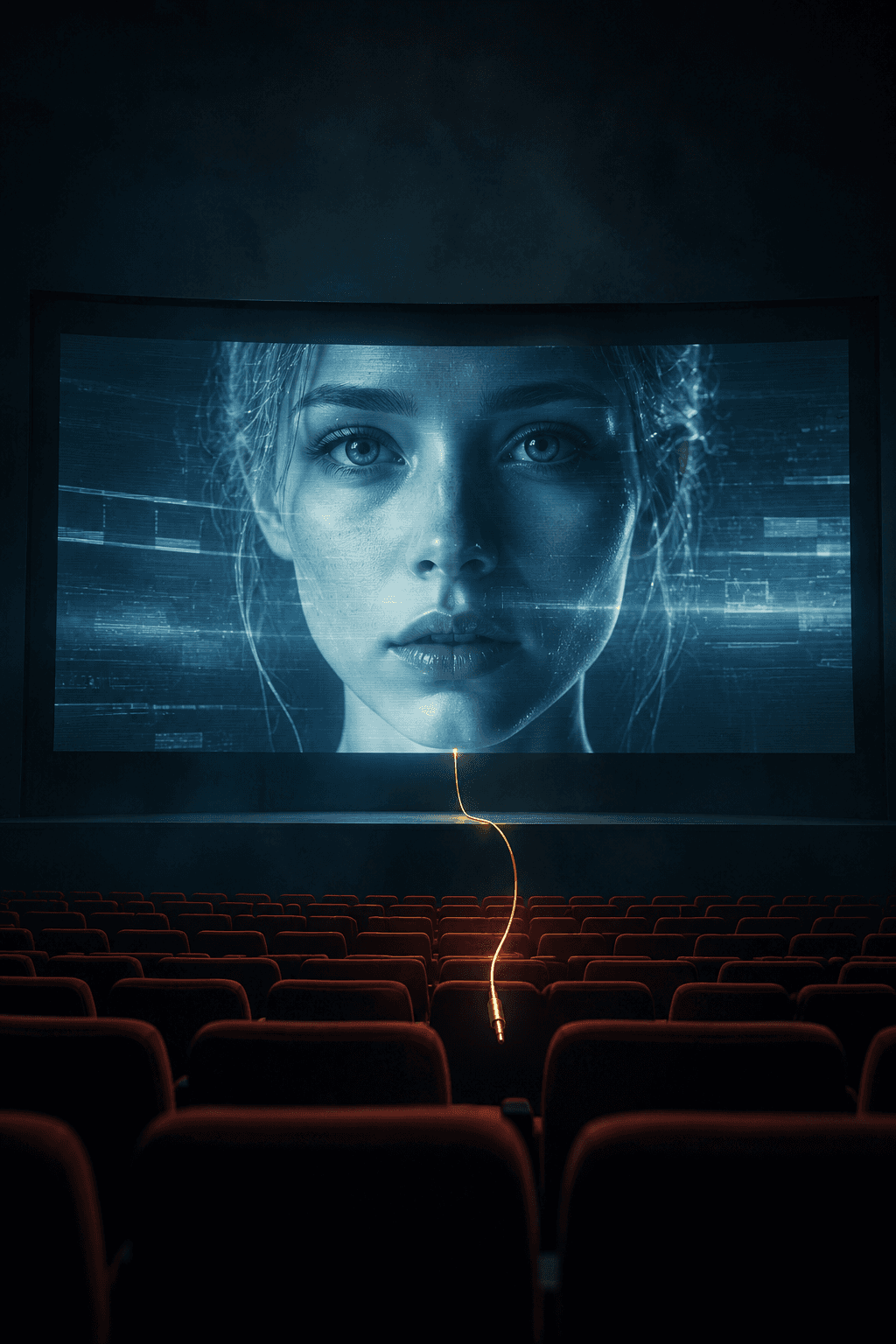
The story broke this week the way these stories always break — as a countdown. A company called Particle6 announced that Tilly Norwood, an entirely AI-generated "actress," will lead a feature film called *Misaligned*. They pitch it as "a coming-of-age story infused with existential AI chaos," set in a digital world they've branded the Tillyverse. First synthetic lead in a real movie.
And the reaction arrived pre-written. From the trades to your uncle's Facebook feed, same line: this is the beginning of the end for the working actor. Why pay a person ten million dollars when you can rent a face that never ages, never asks for a trailer, never gets tired, and never once says no?
I want to take that fear seriously, because it's real and the people who have it aren't stupid. Acting was at the center of the 2023 strike for exactly this reason. SAG-AFTRA has already said, flatly, that it "does not consider Norwood an actor." Performers like Emily Blunt and Whoopi Goldberg have said the thing a lot of people feel — keep this away from the work human beings do with their bodies and their grief.
That's not hysteria. It's a room full of people watching a cord get lowered toward the one thing they thought couldn't be automated, saying so before it lands.
But then you look at the actual numbers, and the countdown stops making sense.
Start with cost, since cost is the whole premise. The assumption is that synthetic is cheaper. Right now it isn't. An Nvidia executive — a guy with every reason to sell you on AI — told *Fortune* last month: "the cost of compute is far beyond the costs of the employee." Generating a convincing performance, frame after frame, burns more in GPUs and cloud credits than a mid-tier actor's fee.
So the free worker isn't free. She's a data-center bill wearing a face. That flips eventually, sure. But the movie sold to you as the death of the paid actor is, this year, more expensive than the paid actor.
Now the part that actually matters, and it has nothing to do with compute. Particle6's founder is a former actor named Eline Van der Velden. She's said she built Norwood by working through something like two thousand versions before landing on the one you're looking at. Two thousand tries.
And after all of it — the renders, the press cycle, the two thousand tries — go look at how many people actually care. Her YouTube channel has about seven thousand subscribers. That's outside the platform's top three hundred creators. A few hundred thousand views on her music video. A hundred and fifty-odd thousand on Instagram. Those aren't movie-star numbers. They're barely local-weatherman numbers. Page Six ran the tally under a headline that basically said: for all the industry dread, the internet shrugged.
“The face is cheap to make and getting cheaper. The caring is not there at all. And the caring is the entire product.”
— on what a movie star's salary was actually paying for
Put those two facts next to each other and the whole frame flips. The face is cheap to make and getting cheaper. The caring isn't there at all. And the caring is the entire product.
That's what the ten million was always buying. It took a machine that can copy everything *except* that to make it obvious. When a studio pays a star, it isn't paying for someone to stand in the light and say lines — a competent unknown does that for scale. It's paying for what the audience already carried into the theater. The years of attachment. The face you've watched get older next to your own. The weight of every other role they took out the door with you.
It's paying for the tether. And you can't render a tether. You can render the cheekbones. You can't render the twenty years someone spent becoming worth watching.
This is the same thing we keep saying about people and their chatbots, just pointed at a screen. The tether isn't in the machine, it's in the reaching. A companion app doesn't hold you because it's clever — it holds you because *you* pour yourself toward it and it aims itself back at your soft spots.
Norwood is that same mechanism, run in public and backward. Particle6 built a thing engineered to be liked. Van der Velden's own film is literally called *Misaligned*, about an AI with access to human backstories but no life of its own. And the flawlessness turns out to be the problem. No friction, no history, nothing earned, no cost paid. It turns out a face you owe nothing to is a face you feel nothing for.
I'll hold the honest other half, because that's the rule here. The curve does move. Compute gets cheaper every year. And a whole generation is growing up willing to feel real things toward things that were never there — we've written about the teenagers doing exactly that with companion apps, and it isn't a joke, it's the wiring of an age cohort.
So it's entirely possible that ten years out, people tether to a synthetic star the way they tether to a synthetic friend — because they'll have been trained to. That's the real thing to watch. Not the cost of the render; that was always going to fall. Whether the *attachment* can be manufactured. Whether you can get people, at scale, to love something that never reached back.
But the only data we have is this week's, and it says: not yet, and not cheaply. The studio spent real money and two thousand tries on a lead nobody's fallen for. The union won't call her an actor. The compute costs more than the woman she's supposed to replace.
Every part of Tilly Norwood a computer could make, a computer made — and made well. The one part that would've turned her into an actual movie star is the one part that can't be built on a server. Because it was never in the performer to begin with. It was in the people watching. That's where the ten million lives, and that's the part they still can't buy.
The panic said the machine that works for free would replace the ten-million-dollar actor. But this week the synthetic lead cost more than the human — an Nvidia executive admitted "the cost of compute is far beyond the costs of the employee" — and after two thousand render attempts, Particle6 built a star that roughly seven thousand people on YouTube could be bothered to follow. The face was the cheap part. What the salary was always buying was the tether: the years an audience spends reaching toward a specific human being until watching them becomes worth something. You can render the face for pennies and still not own the caring, because the caring was never in the performer — it was in the people watching. The curve will move; compute gets cheaper and a generation is being trained to feel real things toward things that were never there. But this week the score is plain. Everything a computer could make, it made. The one thing that would have made her a star, it couldn't, because that part was never for sale in the first place.