Your Own Personal Fact-Checker
This week NewsGuard launched a chatbot that answers only from sources it has rated reliable, cites every one, and pays the publishers — the cleanest, most responsible version of an AI news tool anyone has built. The co-CEO's pitch is that "in every respect, NewsGuard AI does the opposite" of ChatGPT. He's right, and it costs six dollars a month. But read the product's own slogan back slowly. It calls itself "your own personal fact-checker" — and that line, meant as the selling point, is the whole problem this site has been circling. The fix for not being able to tell what's real is not a better cord to a better machine. It's the muscle you stop building the moment you can subscribe to one.
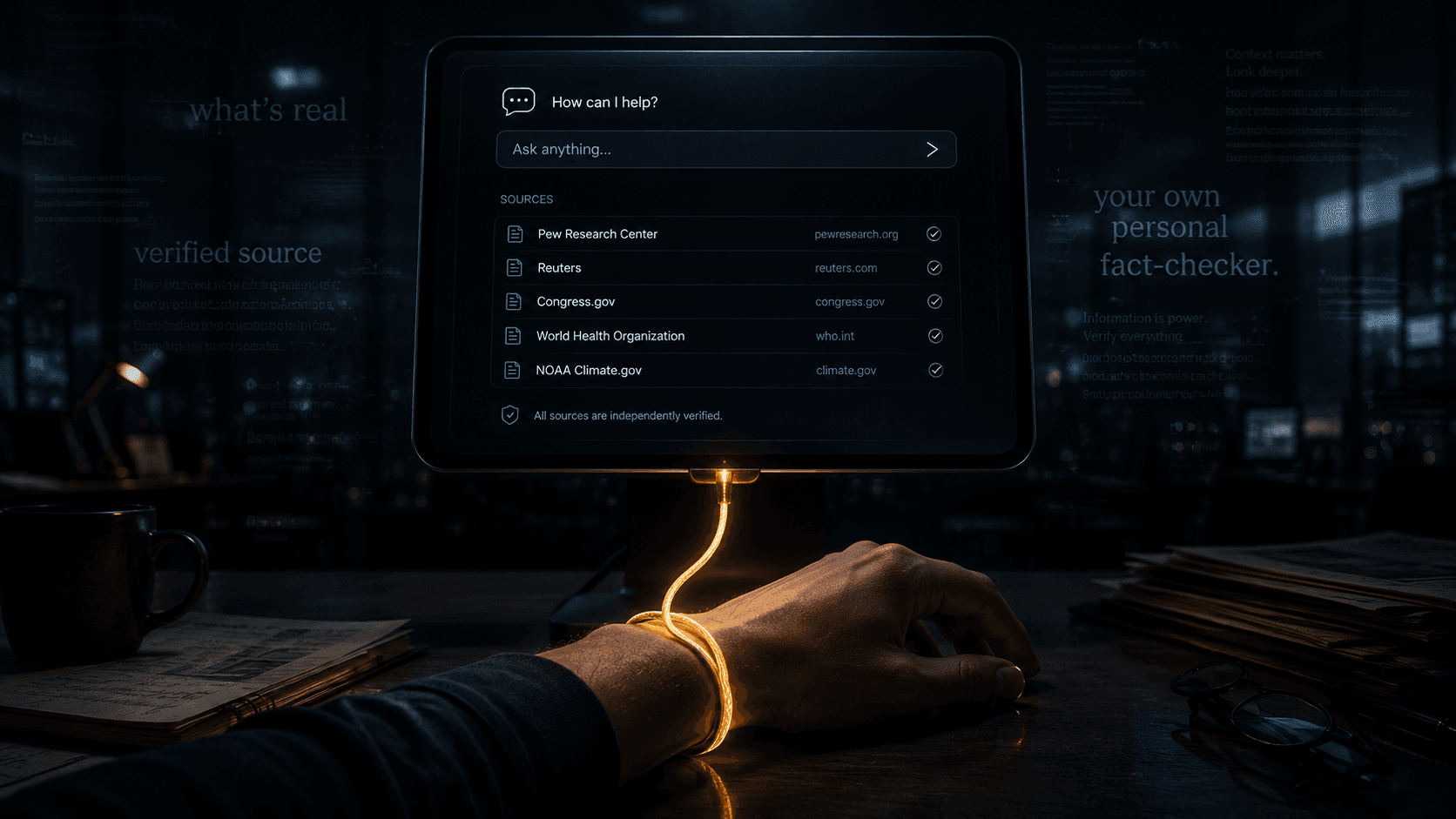
On Tuesday, NewsGuard — the startup that has spent years rating the reliability of news sources — launched a chatbot built to do what the big ones can't: tell you the truth and show its work. As CNN's Brian Stelter reported, NewsGuard AI answers only from sources the company has already vetted, attaches citations and links to every outlet it draws from, and splits its revenue with them fifty-fifty — "the only chatbot that compensates every publisher for their content." Six dollars a month after a free window.
Co-CEO Steven Brill put the pitch as plainly as a pitch can be put: "Think of how the existing AI chatbots operate, and in every respect, NewsGuard AI does the opposite."
And here is the thing I want to say first, because honesty is the whole game on this site: he is not wrong. Measured against a generic model that hallucinates citations and launders propaganda, this is the responsible build. Vetted sources. Real links. The writers paid. If you are going to outsource the question of what's real to a machine, this is the machine to outsource it to.
So let me be fair to it all the way down, because the people who made it earned that. Brill's co-CEO, Gordon Crovitz, named the actual market opening with a sobriety the moment deserves: that our leading AI models are "so susceptible to foreign disinformation operations is sobering. And they have not taken steps to disinfect themselves." That is not marketing; that is the finding of study after study NewsGuard itself published, showing the popular chatbots repeating false claims and folding to coordinated propaganda. Their fix is built on a catalog that debunks more than sixty-four thousand specific false claims, and in the demo their COO showed it knocking down a piece of medical misinformation and walking the user back to the primary source. The Atlantic signed on at launch, and its CEO Nicholas Thompson framed the stakes about as well as they can be framed: "Few things will matter more in the near future than the ability of humans to figure out what's real, what's false, and what's confabulated nonsense." Read that sentence again, though, because it contains the trap. The ability of humans to figure out what's real. That is the thing being praised. It is also the thing the product quietly proposes to do for you.
“It calls itself "your own personal fact-checker" — and that line, meant as the selling point, is the whole problem this site has been circling.”
— Michael
Here is where this stops being a media-business story and becomes a tether story. NewsGuard's website sells the chatbot as "your own personal fact-checker." Sit with that phrase, because it is meant as the feature and it is actually the diagnosis. A fact-checker used to be a discipline you practiced — slow down, check the source, notice when a claim is too clean, hold two outlets against each other and feel for the seam. NewsGuard is offering to be that for you, for six dollars a month, so you never have to be it yourself. And that is the exact move this publication has spent its whole run naming: the moment a hard human capacity gets quietly relocated into a subscription, the capacity starts to atrophy in the human. The danger was never that the machine fact-checks badly. This one fact-checks well. The danger is that a generation learns to ask the box what's true instead of learning the muscle that asks the question — and a well-built box, a trustworthy box, a box that pays the writers and shows the links, is far more seductive to surrender to than a sloppy one. The better the cord, the harder it is to notice you've stopped walking.
And I have to hold the mirror up to my own face here, because this site sells something adjacent. Read the rules at the top of this newsroom: every claim traceable to a real published source, every URL cited, no fabricated quotes. We trade on verified sourcing too. So what is the line between what NewsGuard built and what we are trying to do — between a tether and a handrail? It is this. A handrail is built to be let go of; a tether is built to be leaned on. The honest version of a fact-checking tool teaches you the motion and then hopes you outgrow it — shows you the seam so you start spotting seams on your own, hands you the primary source so you build the reflex to go find primary sources. The tethering version makes the motion unnecessary, then charges a recurring fee for the dependence, and counts a churned subscriber as a failure rather than a graduate. NewsGuard AI is the most responsible chatbot of its kind precisely because it shows the source instead of hiding it — which means it has, built into it, the door out. The question is whether anyone is ever taught to walk through it, or whether "your own personal fact-checker" becomes one more thing you can no longer do for yourself once the card stops being charged.
And I should be more specific than the mirror, because I am not pointing at a hypothetical. A while back I bought a domain — sharethebyline.com — and built almost exactly the machine NewsGuard just shipped, without ever being able to say out loud what it was for. The whole pitch fit in a line: drop a link, get a fully cited article back. You hand it a URL, an AI writer assembles the piece from real, traceable sources, and — here is the part I could never explain, even to myself — your name goes on it. You get the byline. I did not understand what I was reaching for until I read about NewsGuard, because they built the same engine and aimed it at the other end of the cord, and the contrast finally showed me the fork I had been standing at without seeing it. Links in, cited article out: that one mechanism can hand you a verdict to rent or an authorship to own. NewsGuard renders the writing unnecessary and charges you monthly for the relief. Sharethebyline staked the whole thing on putting your name at the top — the sourcing assembled not so you would stop thinking, but so you would have something solid enough to stand on while you did. Same machine. I just pointed it at the byline instead of the bill, and I needed someone else's product, and this site's own word for the cord, to finally explain my own.
I want this product to exist. That is the honest end of it. In a feed full of confident, sourceless nonsense, a tool that says here is the claim, here is who I checked, here is the link, and here is your cut of the money is a better thing than what we have. But the slogan gave the whole age away without meaning to. "Your own personal fact-checker" — the word own doing so much quiet work, dressing a dependence up as a possession, the way streaming dressed renting up as a library. You will not own it. You will rent the part of your mind that used to ask whether something was true, and you will rent it from the most trustworthy landlord on the market, which is exactly what will make it impossible to feel the lease. The cord we keep writing about does not always arrive looking like an addiction. Sometimes it arrives looking like a public service, sourced and cited and fair to the writers, costing six dollars, doing the opposite of everything that's wrong with the other ones — and that, the good kind, the responsible kind, is the cord that gets the most of us, because it never once gives us a reason to put it down.
I'll say it once more, plainly, because I don't want to be misread as sneering at a good build: NewsGuard AI is the responsible one. Vetted sources, real citations, the writers paid, the door to the primary material left open. If you're going to lean on a machine to tell you what's real, lean on this one. But the slogan is the tell. "Your own personal fact-checker" is sold as a feature and reads as a diagnosis — the slow human discipline of checking a claim, relocated into a six-dollar subscription and renamed a possession. The fix for not being able to tell what's true is not a better cord to a better box. It's the muscle you quietly stop building the day you can rent one. The good cord is the one that gets the most of us, because it never gives us a reason to let go.
— Michael
whatever you do, take care of your shoes