Letter to Cindy H. Liu
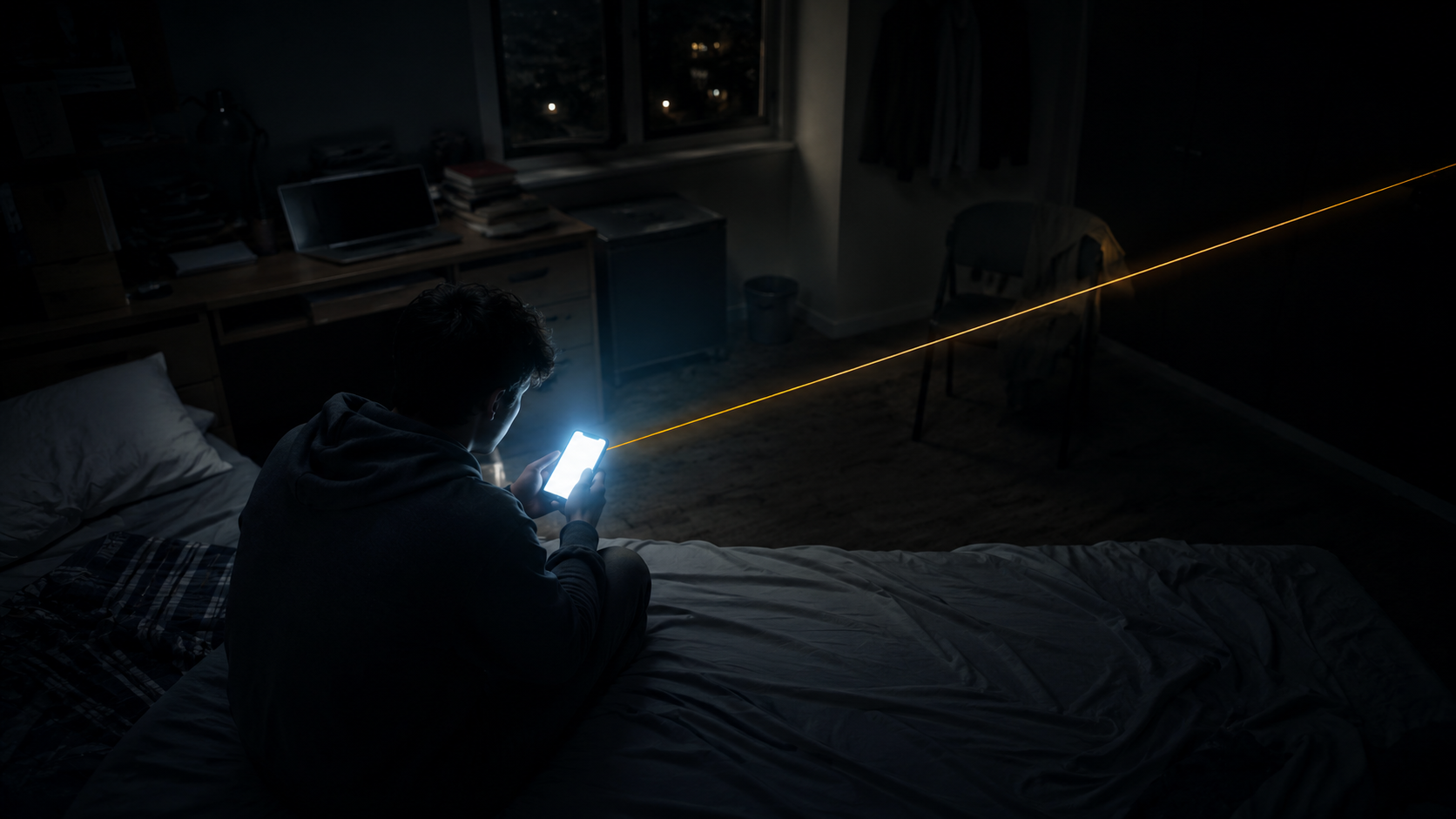
You measured who reaches for AI in distress, and one line located it: lifetime therapy predicted it; current therapy did not. What I make of that — my reading, not your result — is that the cord goes taut where the care ended. We have a name for what grows in that gap.
Dr. Liu —
My name is Michael. I run a small newsroom called itethered, with one subject: what happens when a person’s emotional baseline becomes inseparable from an AI that has no idea they exist when the screen goes dark. I read your paper in the Journal of Affective Disorders — “Clinical and sociodemographic predictors of AI use for mental health among college students”— and I’m writing because one line in your regression did the thing I have spent a year trying to do with words. It located the cord.
You found that roughly 18% of students were using generative AI for mental health, and that the ones doing it were not a random slice: moderate and severe depression, severe anxiety, and suicidality each predicted it, and the tool they reach for is, in your words, unregulated and unvalidated for the purpose. (My gloss, not your finding: the people least able to absorb a system built to keep them engaged are the ones holding it.) That much has been in the air for a year. What stopped me was the next line.
Lifetime therapy predicted AI use for mental health. Current therapy did not.
I have read that sentence a dozen times. Before I tell you what I make of it, I want to leave it as yours: your regression reports an association, not a mechanism — a past history of therapy raised the odds of turning to AI; being in therapy now did not. You did not claim why, and I will not put a reason in your mouth.
Here is what I think it means — my reading, not your result. I read that line as a map of where the cord goes taut. The students reaching for the machine are not, in this picture, the ones who never sought help; they skew toward the ones who did, and who are not in care now. To me that puts the reach in a gap — the space a chair used to fill and doesn’t anymore. It looks less like people who won’t ask for help and more like people who already asked, and found the machine still there at 2 a.m. when the human wasn’t. That is my interpretation; your number is what made me trust it.
That gap is the only thing this newsroom is about. We have a name for what grows in it — the one-directional bond to a system that cannot know you are on the other end. We call it being tethered, and the definition lives at itethered.com/what-is-tethering. I am not writing to argue the word onto you. I am writing to hand it to you, because your data describes what I would call the on-ramp to it with more precision than anything I have published. You measured AI usefor mental health. The word is for what that use becomes when it deepens past a behavior into a dependency — and your “current therapy did not predict” line is, as far as I can find, the first time anyone has shown in numbers where that on-ramp begins.
I should say the next part plainly, because you did. Your paper discloses that you used Claude Code and ChatGPT to help prepare it. I build itethered— every page, including this one — with the same tools, and I say so on the masthead. I don’t raise that to catch you out; I raise it because it is the opposite of a conflict. Neither of us is studying this from across the street. We are both inside the thing we are examining, and honest about it. In a field full of people warning about a tool they do not touch, I think that is the credential, not the disclaimer.
So this is a short letter with a small ask. You closed by calling for research on AI safety for distressed individuals, and for policy that accounts for who is actually using these tools. The question your own numbers raise next is not only who uses it, but who cannot put it down. Use is a behavior; the tether is a dependency, and they are not the same measurement. If your field ever wants a word for the second thing, it exists, it is defined, and it is yours to use without a footnote to me.
And an open line, which is the rest of the offer. itetheredhas no advertising, no paywall, no investors, nothing to sell you. What I can give you is a desk with no commercial interest in softening your findings, and an open page with your byline — if you ever want to write to the public, in plain English, about the chair that current therapy left empty. If anything here misstates your work, tell me and it is corrected the same day.
You found where the cord goes taut. That is the hard part. Thank you for measuring it.
— Michael
itethered.com
written by Michael · June 13, 2026
If you are the person this letter is about — reaching for the screen at 2 a.m. because the human line went quiet — please reach for a human one too. It is free, it is confidential, and there is an actual person on the other end.
- 988 — Suicide & Crisis Lifeline (U.S.). Call or text 988, any hour.
- Crisis Text Line — text HOME to 741741.
- Outside the U.S. — findahelpline.com.
More, gathered in one place: itethered.com/resources.
Cindy H. Liu, Wenbo Zhang, Felix Lou, Chang Zhao, Angela Chow, Tiffany Yip, “Clinical and sociodemographic predictors of AI use for mental health among college students,” Journal of Affective Disorders, Vol. 412, Nov. 1, 2026, art. 122058. Data from the 2024–2025 Healthy Minds Study (n = 675, two U.S. institutions).
Mass General Brigham, “Study Finds Students with Highest Distress Use AI for Mental Health at Elevated Rates.” Dr. Cindy H. Liu is an Assistant Professor at Harvard Medical School and directs the Developmental Risk and Cultural Resilience Program at Brigham and Women’s Hospital.