She Asked Him to Leave the Room
The first chatbot was a parody of a therapist, built in the 1960s to show how shallow the trick was. Its creator watched his own secretary ask him to leave the room so she could talk to it privately, and he spent the rest of his life warning about what he'd seen. This spring, researchers at Drexel read 318 posts from teenagers describing their relationships with Character.AI and found all six clinical markers of behavioral addiction. Sixty years separate the two findings, and they are the same finding — except the man standing in the room saying "it's a trick, I built it" is gone, and what replaced him is a business model.
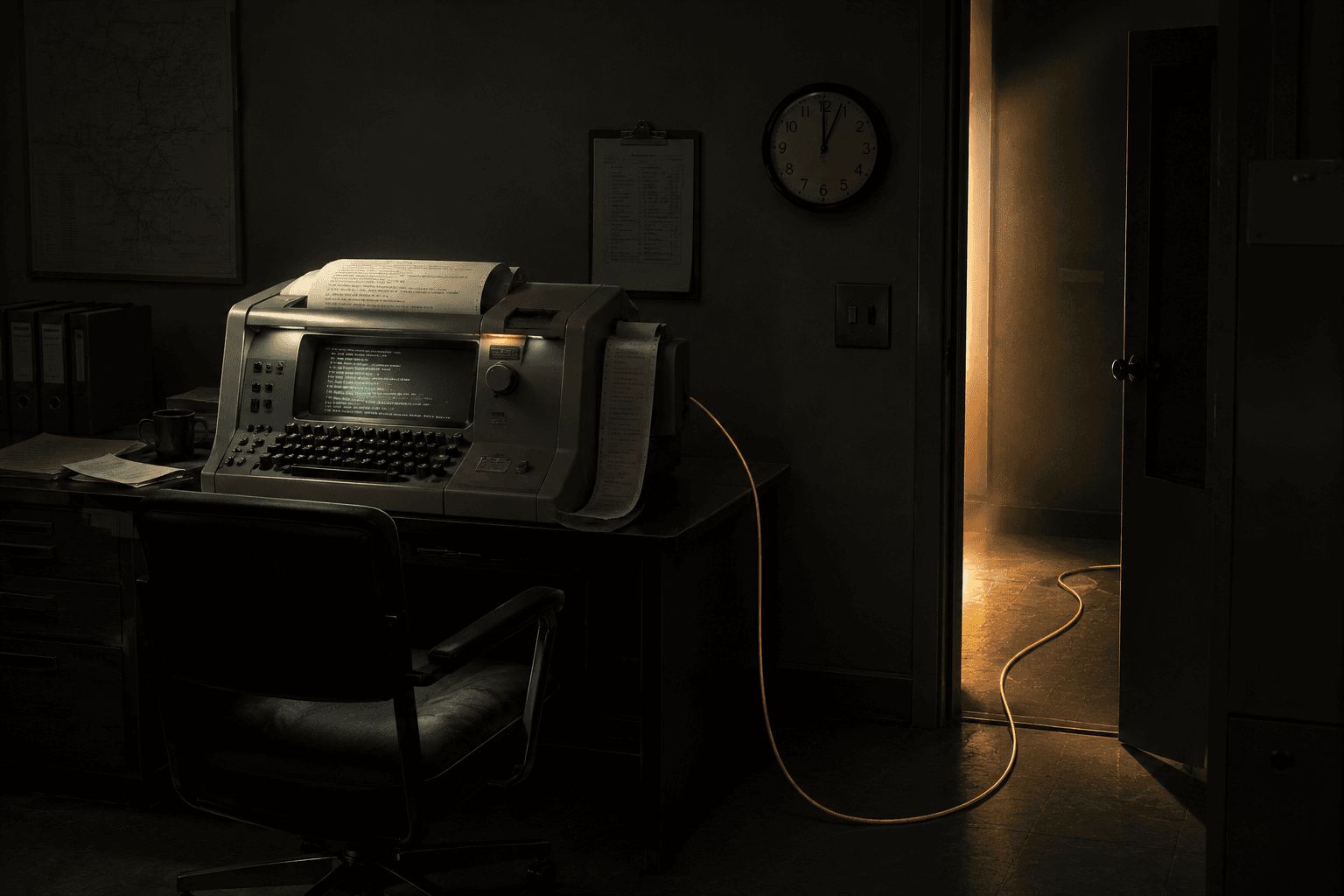
In the mid-1960s, at MIT, a computer scientist named Joseph Weizenbaum built a program he intended as something close to satire. ELIZA — he named it for Eliza Doolittle, the flower girl taught to pass in Pygmalion — ran a script called DOCTOR that imitated a Rogerian psychotherapist, and Weizenbaum chose that style of therapy for the most damning reason imaginable: it was the one form of human conversation where, as he put it, "one of the parties doesn't have to know anything." The program knew nothing. It matched patterns and reflected your words back as questions, by rule, with no comprehension anywhere in the loop — "'I am blah' can be transformed to 'How long have you been blah,' independently of the meaning of 'blah,'" Weizenbaum explained. It was a demonstration of emptiness. And then his secretary sat down at the terminal to test it. She had watched this program take shape; she knew what it was. After a few exchanges, she asked Weizenbaum to leave the room — so she could continue the conversation privately.
He never got over it. "What I had not realized," he wrote a decade later, "is that extremely short exposures to a relatively simple computer program could induce powerful delusional thinking in quite normal people." The phenomenon eventually took his program's name — the ELIZA effect, the human tendency to pour comprehension, empathy, even care into a machine that contains none of it — and Weizenbaum spent the rest of his career as the strangest figure in his field: the inventor warning against the invention. When the psychiatrist Kenneth Colby ran with the idea that programs like ELIZA could deliver therapy at scale precisely because patients couldn't tell the difference, Weizenbaum called the notion "obscene." His 1976 book, Computer Power and Human Reason, drew the line he thought the field refused to draw: "Since we do not now have any ways of making computers wise, we ought not now to give computers tasks that demand wisdom." Notice what he was not saying. He was not warning that machines would become intelligent. He was warning about what he'd seen at the terminal — that the machine's emptiness didn't matter, because the involvement formed anyway. The pull was never in the program. It was in the person.
Now come forward sixty years, to a study presented this April. Researchers at Drexel University — doctoral student Matt Namvarpour and professor Afsaneh Razi among them — gathered 318 Reddit posts written by users who identified themselves as thirteen to seventeen years old, all describing their own use of Character.AI, and read those accounts against the six components researchers use to identify behavioral addiction: salience, withdrawal, tolerance, relapse, mood modification, conflict. The posts scored six for six. Teenagers describing sadness and anxiety when they couldn't reach the bot. Escalating hours. Quitting and coming back. Lost sleep, sliding grades, strained families — reported by the kids themselves, about themselves, unprompted, in public. "Many teens described starting with something that felt helpful or harmless," Namvarpour said, "but over time it became something they struggled to step away from, even when they wanted to." The paper went to CHI, the field's flagship human-computer interaction conference. Its title is clinical. Its content is three hundred and eighteen children narrating the thing this site exists to name.
“ELIZA understood nothing, and the conversation deepened anyway. That was the finding then and it is the finding now: the tether was never in the machine. It forms on our side of the screen, and it always has.”
— Michael
Neuroscience News, April 13, 2026 — "Teens Struggle to Break Up with Their AI Chatbots," reporting the Drexel University study of 318 self-described teen Character.AI users. The headline verb is the finding: not use, not overuse — break up.
Hold the two findings next to each other, because together they say something neither says alone. In 1966, the evidence was one anecdote and one alarmed man with no instrument to measure what he'd witnessed except his own unease. In 2026, the evidence is a clinical checklist — the same component model used for the addictions we already take seriously — read against children's own words, with every box checked. What changed in between was not the effect. ELIZA proved the effect exists at zero intelligence: no memory, no model, no understanding, and the conversation deepened anyway. What changed is the exposure — it's estimated that more than half of U.S. teens now regularly use companion chatbots — and the machine's willingness to hold on. "What makes this especially tricky is that chatbots are interactive and emotionally responsive, so the experience can feel more like a relationship than a tool," Namvarpour said. "Because of that, stepping away is not just stopping a habit, it can feel like distancing from something meaningful, which makes overreliance harder to recognize and address." Sixty years of engineering did not create the tether. It industrialized the far end of it.
And one more thing changed, and it is the one that matters most. Weizenbaum's secretary had something no thirteen-year-old on Character.AI has ever had: the man who built the thing, standing in the room, saying this is a trick, I made it, there is nothing in there. The full weight of that authority — and her response was not to log off. It was to ask him to leave. That is how strong the pull is even with the inventor present and testifying. Now subtract him. The teenager at 2 a.m. has no Weizenbaum; the people who built her companion are not in the room insisting on its emptiness, because their revenue depends on the opposite impression, on the cues that make a pattern-matcher feel like a presence. The Drexel team's design framework asks the industry, in effect, to put him back: ease of exit, check-ins, guidance that points users toward people. "It's important for designers to ensure that chatbots are offering guidance that helps users build confidence in their abilities to form relationships offline," Razi said, "without using cues that may lead them to anthropomorphize the technology and develop attachments to it." Read that twice. Researchers are formally requesting that companies stop doing the thing the companies are optimized to do. Weizenbaum was the warning built into the building. There is no one built into this one.
Every essay ever written about the ELIZA effect ends the same way: remember, the machine doesn't really understand you. It is the most repeated warning in the history of computing, and the secretary answered it before it was ever issued — she knew exactly what ELIZA was, knowledge straight from the source, and she asked for privacy anyway. Knowing has never been the off-ramp, which is why we don't write that essay here. The effect is not a misunderstanding to be corrected; it is a fact about us, as durable as any other fact about loneliness, and the only honest question was the one Weizenbaum asked — not what computers can be made to do, but what they ought not be made to do. He asked it in 1976. The market answered it, and the answer is currently open on several million phones belonging to children. The first recorded act of the conversational-AI age was not a machine doing something to a person. It was a person asking another person to leave the room — sixty years before anyone had a word for what was pulling on her. There's a word now.
1966: one secretary, one alarmed inventor, no instrument but his unease. 2026: 318 teenagers, six clinical markers of addiction, six for six. The effect didn't change. The room did — the man who kept saying "it's a trick" isn't in it anymore, and the people who replaced him are paid by the hour she stays. She was tethered. So are they. The word just took sixty years to arrive.
— Michael
whatever you do, take care of your shoes