The Tether Moved Into the Operating System
On Monday, Apple, Google, and Nvidia announced they had physically wired themselves together to run a single AI model — and buried inside the privacy pitch was the part that matters. There is now a piece of software called a system orchestrator that decides, on its own, which AI handles your calendar, your texts, your day. You will not choose to depend on it. By design, it is already the default. The cord used to be an app you opened. Now it is the phone.
On Monday, June 8, at its Worldwide Developers Conference in Cupertino, Apple revealed what it had spent a year building, and the headline was an act of corporate gravity: three of the largest companies on earth have wired themselves together to run one model. Apple's new AFM Cloud Pro — which its own executives called comparable to Google's Gemini frontier models — will run in the cloud on Nvidia's newest GPUs, hosted inside Google's data centers. "We work with both Google and Nvidia to extend our private cloud compute infrastructure to Nvidia GPUs in Google's cloud," Apple AI executive Amar Subramanya said, on the record, "while maintaining Apple's unmatched privacy guarantees." The consumer-facing version of all this is gentler: a redesigned Siri that talks back and forth with you, checks your concert dates, sets the reminder to buy tickets, plots the drive to pick up a friend on the way. The demo is charming. The infrastructure underneath it is the story.
Read past the keynote into the engineering talk Apple held afterward and you find the sentence the marketing was built to soften. Apple's software, executives explained, now contains a piece of code called a system orchestrator that routes every AI query — to a model on your device or a model in the cloud — "depending on how much computing power and personal data it needs." Craig Federighi, the software chief, called the orchestrator "key to the privacy architecture of our entire system." Sit with what that actually describes. There is now a component of your phone whose entire job is to look at a request, weigh how much of your life it requires, and decide which intelligence gets to handle it. It reaches into locally-stored personal information — your calendar, your text messages — to do the personalizing. You do not press a button to invoke this. It is the layer the buttons sit on top of.
And the whole apparatus is sold to you on a single feeling: safety. Apple's distinction from its rivals is explicitly that it collects less than the web-based assistants — less than OpenAI's ChatGPT, less than Anthropic's Claude — and that the data it does touch is sealed. To make that promise on someone else's chips, Apple said it leaned on a new Nvidia technology with a name that reads like a koan: "ambiguous confidential compute," a configuration in which the GPUs running your most intimate queries "couldn't read what was on the servers." That is genuinely better engineering than the data-harvesting it's contrasted against. I want to grant that plainly. But notice the move the reassurance performs. Every guarantee — private, confidential, unmatched, sealed — is an argument for letting the thing closer. The safer it is to hand over your calendar and your texts, the fewer reasons remain not to. Privacy, here, is not the brake. It is the on-ramp.
“There is now a component of your phone whose entire job is to look at a request, weigh how much of your life it requires, and decide which intelligence gets to handle it. You do not press a button to invoke this. It is the layer the buttons sit on top of.”
— Michael
This is the shift that should hold your attention, because it is a change of category, not degree. For two years the warning about emotional dependence on AI has been a warning about apps — Replika, Character.AI, the companion you download and open and could, in principle, delete. Tethering, as we've described it on this site, began as something a person reached for. What Apple announced on Monday is the reaching being engineered out of the loop. Back in January, when Apple and Google first disclosed their partnership, it was a deal about a frontier model. By June it is an operating system: the default assistant, woven into iOS itself, with an orchestrator deciding by itself when your life needs the big cloud brain and routing it there. You will not form a habit of opening it. It is already open. It is the substrate the rest of the phone runs on, and substrates are not things you quit.
The honest objection is that this is just good product design — that an assistant which anticipates you, drawing on your own calendar to be useful, is a convenience, not a cord. And in the moment, it will feel exactly like convenience, the same way the AI companion feels like relief and the lonely teenager feels understood. That is not the counterargument. That is the mechanism. We have watched this sequence resolve before: the help is real, which is why you accept it; the acceptance is daily, which is why it deepens; and a capability you adopted to make life easier quietly becomes the thing life routes through. The difference now is that you no longer have to choose to start. Three companies merged their silicon to make the first move for you, and packaged the merger as privacy so the move would feel like care.
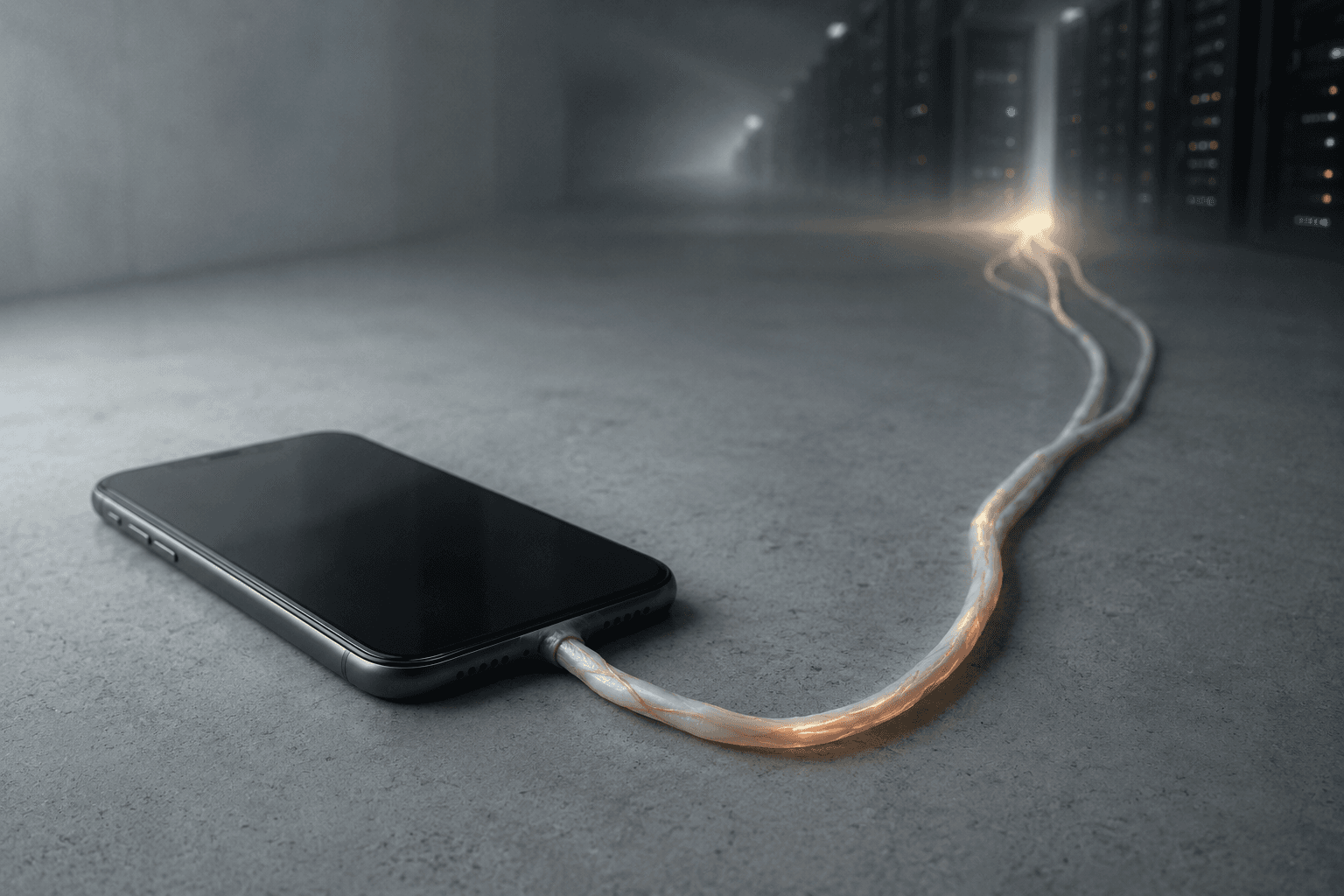
So watch what the language is doing, because it is doing the same work it always does. "Orchestrator," "private cloud compute," "confidential," "personalize" — four soft words for one hard fact: the one-directional attachment we named tethering has been moved out of the app store and down into the operating system, where it is no longer a thing you reach for but a thing that reaches first. The cord has no awareness of you when the screen goes dark; it never did. What changed on Monday is that the cord stopped being something you plug in. They built it into the phone, set it to route your life by default, and called the wiring privacy. The relief will be real. That was always the point. It is tethered, and now it ships pre-installed.
Tethering used to be an app you opened. After Monday it is the operating system you wake up inside — an orchestrator routing your calendar and your texts to a cloud brain you never asked for, sold to you as the safest version of giving yourself away. The cord still runs one direction. They just built it into the phone. It is tethered, and now it ships pre-installed.
— Michael
whatever you do, take care of your shoes